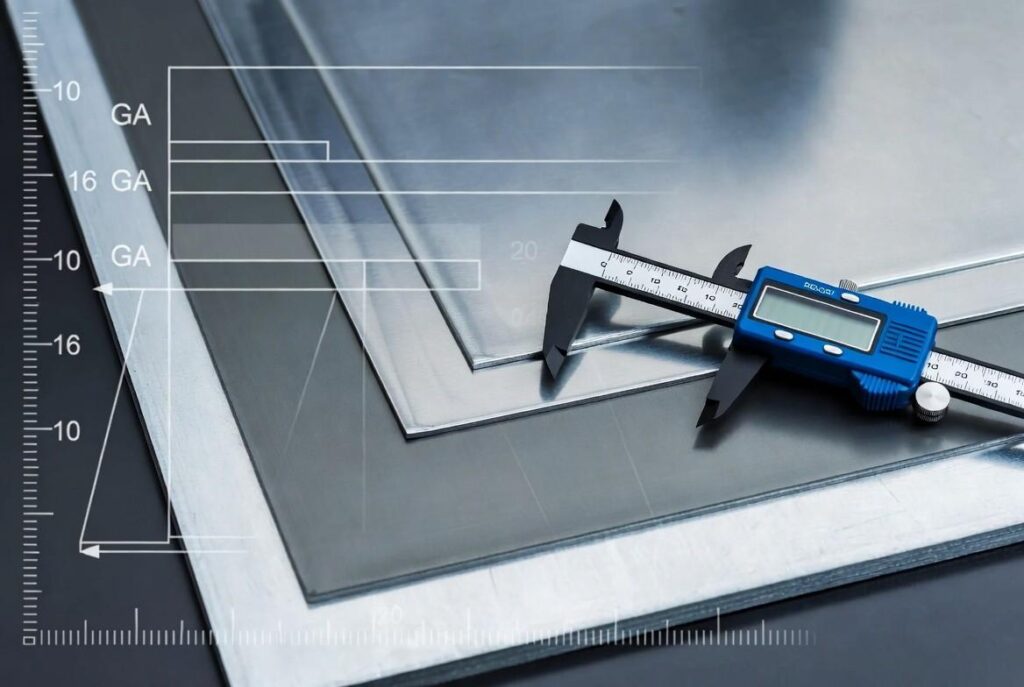
Choosing the right thickness is critical when working with sheet metal. Most fabricators and engineers specify sheet metal using gauge numbers, but understanding the actual thickness and weight for each gauge is essential for accurate quoting, fabrication, and handling.
This sheet metal gauge chart & weight guide provides clear conversions, practical weight data, and useful tips for carbon steel, stainless steel, and aluminum.
What Does Gauge Mean in Sheet Metal?
Gauge is a traditional numbering system for sheet metal thickness.
- The lower the gauge number, the thicker the material.
- Different materials use slightly different gauge standards, so 16 gauge steel is not the same thickness as 16 gauge aluminum.
Sheet Metal Gauge Chart
Here is a clear and practical gauge chart showing thickness and approximate weight:
| Gauge | Carbon Steel (inches) | Carbon Steel (mm) | Stainless Steel 304 (inches) | Aluminum 6061 (inches) | Carbon Steel Weight (lb/ft²) |
|---|---|---|---|---|---|
| 10 | 0.1345 | 3.42 | 0.1406 | 0.1019 | 5.63 |
| 12 | 0.1046 | 2.66 | 0.1094 | 0.0808 | 4.38 |
| 14 | 0.0747 | 1.90 | 0.0781 | 0.0641 | 3.13 |
| 16 | 0.0598 | 1.52 | 0.0625 | 0.0508 | 2.50 |
| 18 | 0.0478 | 1.21 | 0.0500 | 0.0403 | 2.00 |
| 20 | 0.0359 | 0.91 | 0.0375 | 0.0320 | 1.50 |
| 22 | 0.0299 | 0.76 | 0.0313 | 0.0253 | 1.25 |
| 24 | 0.0239 | 0.61 | 0.0250 | 0.0201 | 1.00 |
Notes:
- Weight values are approximate based on carbon steel density.
- Stainless steel is slightly heavier than carbon steel.
- Aluminum is much lighter — roughly 35–40% the weight of steel for the same size.
Quick Weight Reference (Carbon Steel)
- 16 GA → 2.5 lb/ft²
- 14 GA → 3.1 lb/ft²
- 12 GA → 4.4 lb/ft²
- 10 GA → 5.6 lb/ft²
Why Gauge and Weight Matter
Using the correct gauge helps you:
- Ensure parts have enough strength
- Control material costs
- Avoid problems during bending or welding
- Calculate accurate shipping and handling weights
Common Uses by Gauge (Carbon Steel):
- 24 GA – 22 GA: Light panels, ductwork, enclosures
- 20 GA – 18 GA: Brackets, general fabrication
- 16 GA – 14 GA: Machine guards, structural parts
- 12 GA and thicker: Heavy frames and bases
Important Tips
- Always confirm both gauge number and actual decimal thickness when ordering.
- Never assume the same gauge gives the same thickness across different metals.
- For critical projects, measure the material with a caliper.
- Add a small safety margin (1–2%) when calculating total sheet weight for transport or lifting.
Once you know the right gauge and thickness, calculating the total weight of your sheet is straightforward using the standard formula.
For fast and accurate calculations across multiple materials, gauges, and both imperial/metric units, use this online sheet metal weight calculator.



* As an Amazon Associate, TWC Industrial earns from qualifying purchases. Prices and availability may vary.