CNC Woodworking Project Foundations · KB-013
Solid Wood Movement in CNC Projects
Design CNC-cut solid wood parts around grain direction, moisture change, flatness and joinery instead of treating wood like stable plastic.
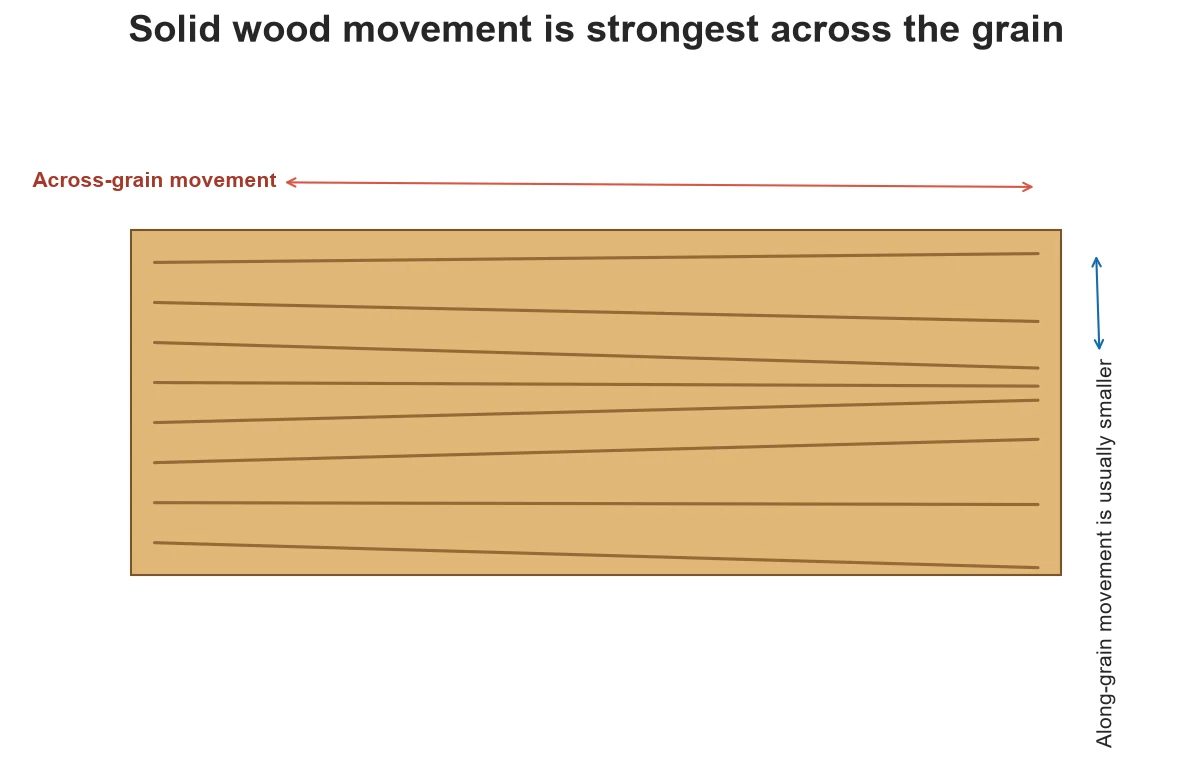
CNC accuracy cannot stop solid wood from responding to moisture. A part can leave the router on size and later cup, shrink or expand across the grain. Good design distinguishes machining error from expected material behavior and allows assemblies to move without splitting.
Movement is directional
Wood changes dimension much more across the grain than along it. The amount varies by species, cut orientation and moisture change. A wide panel therefore needs more consideration than a narrow rail. Do not lock a wide solid panel across its grain with a rigid CNC-cut feature unless the design specifically accommodates movement.
Flatness affects Z-dependent work
A bowed board changes pocket depth and V-carve width even when machine motion is correct. Support and secure the stock without forcing it into a shape that springs back after release. Surface machining can create a reference, but removing material may also release internal stress. Recheck the part after roughing and before critical finishing.
Place features with grain in mind
Thin tabs, narrow lettering and sharp projections can break differently depending on grain direction. Orient long fragile features with supportive grain where practical, add radii and leave machining allowance for cleanup. Test short-grain features before using them in an important part.
Separate seasonal allowance from cutting clearance
A drawer clearance or sliding joint may need immediate machining fit plus allowance for later moisture movement. These are not the same value. Record expected service environment and grain relationship. Use established woodworking design practice rather than adding an arbitrary amount around every feature.
Finish cannot be an afterthought
Coatings can slow moisture exchange but do not make solid wood dimensionally inert. Machine and finish test pieces from representative stock, coat faces and edges consistently where the finish system requires it, and allow the material to reach suitable shop conditions before final fitting.
Design with a moisture range
Record the stock condition at machining and consider where the completed object will live. A panel installed across its grain needs a connection that accommodates predictable movement instead of relying on glue or screws to restrain it. The appropriate allowance depends on species, grain orientation, dimensions and service environment.
Read the board before nesting
Mark face, grain direction, defects and preferred presentation on the physical board, then reflect those constraints in the digital nest. Keep fragile short-grain details away from checks and knots. If appearance matters, preview how adjacent parts will read after assembly rather than treating the board as anonymous rectangular stock.
Decision table
| Design situation | Movement concern | Better question |
| Wide tabletop | Across-grain expansion | Can fasteners allow movement? |
| Deep pocket | Board flatness and released stress | Will depth remain uniform after unclamping? |
| Cross-grain slot | Changing fit | What service environment is expected? |
| Thin decorative feature | Short-grain breakage | Can orientation or radius improve strength? |
Worked situation
A solid-wood lid fits its box immediately after cutting but binds weeks later. Before changing tool compensation, measure grain direction, moisture conditions and where clearance closed. Redesign the cross-grain relationship or service allowance instead of treating seasonal movement as machine inaccuracy.
Practical checklist
- Mark species and grain direction.
- Condition and inspect stock.
- Plan cross-grain movement.
- Recheck dimensions after roughing and finishing.
Frequently asked questions
Can finish stop wood movement?
It can slow moisture exchange but does not eliminate movement.
Should every board be surfaced on the CNC?
Only when the setup and material plan support it; surfacing can release stress and consumes thickness.
Why did a correct pocket become uneven?
Stock may not have been flat or may have moved after material removal.
Sources and editorial use
Sources support the technical facts in this original explanation. Their text and images have not been republished.
- Wood Handbook: Wood as an Engineering Material — USDA Forest Products Laboratory
- Woodworking eTool: Routers — U.S. Occupational Safety and Health Administration