CNC Woodworking Project Foundations · KB-012
CNC Routing MDF: Clean Edges, Dust Control and Finishing
Understand why MDF cuts consistently yet demands careful dust extraction, edge finishing, workholding and moisture protection.
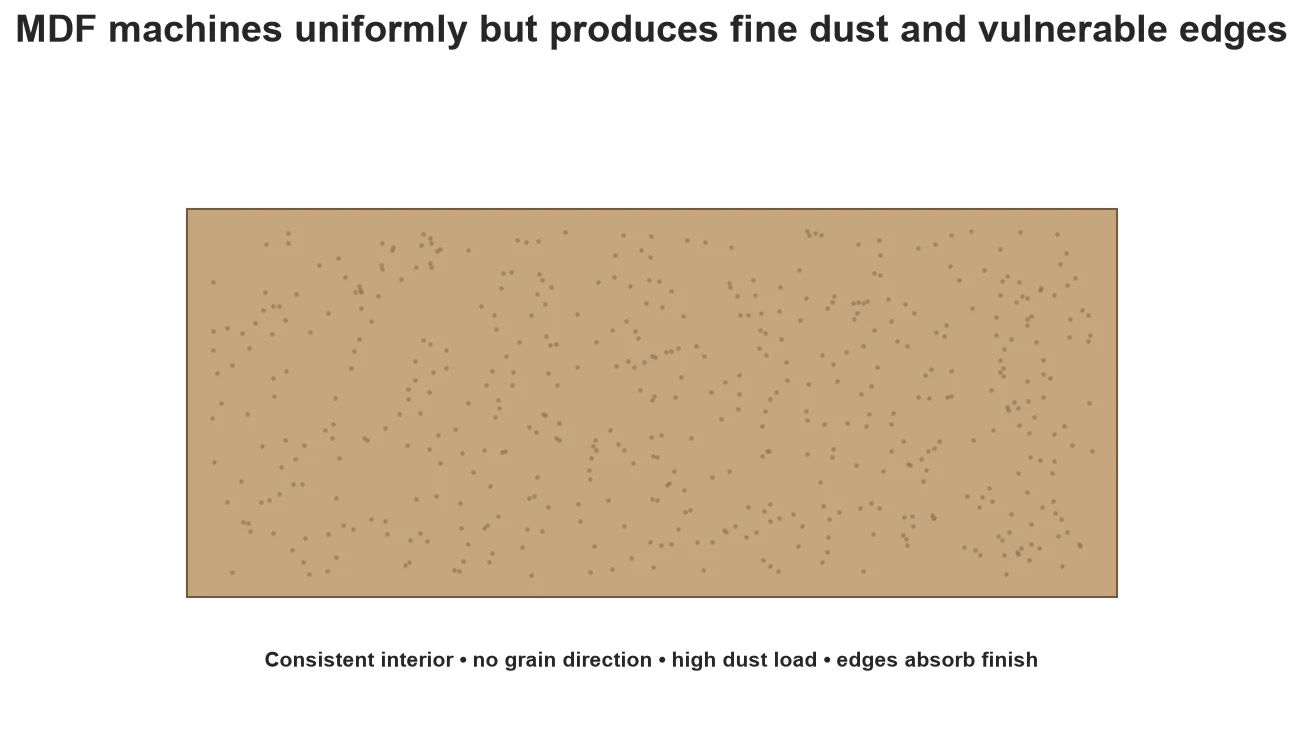
Medium-density fiberboard has no natural grain direction and usually machines more uniformly than solid wood. That makes it useful for templates, painted signs and prototypes, but its fine dust, weak unsealed edges and sensitivity to moisture require a deliberate workflow.
Use uniformity where it helps
Pockets, lettering and curves are not interrupted by alternating grain, so MDF is useful when consistent geometry matters. It can also reveal machine or toolpath errors without grain confusing the result. Uniformity does not mean identical products: density, binders, surface treatment and moisture resistance vary by grade and manufacturer.
Expect a high dust load
Routing turns MDF into fine particles rather than large chips. Effective local extraction at the cutting zone, enclosed transfer and disciplined housekeeping are central controls. A dust shoe that looks busy is not proof of adequate capture. Inspect what escapes, check airflow and collector loading, and follow applicable exposure and combustible-dust requirements.
Protect the cutting edge and tool holder
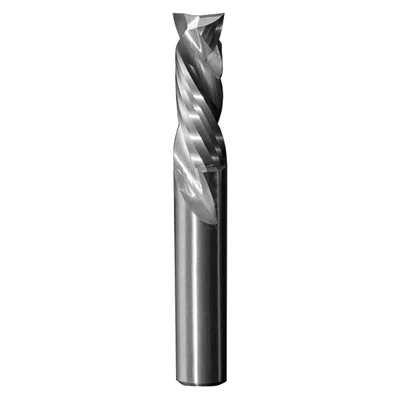
A dull cutter increases heat and leaves fuzzy or glazed edges. Fine dust can enter collet slots and mating surfaces, affecting runout. Isolate power before cleaning, keep the tool-holding stack clean and use cutter geometry supported by its manufacturer for composite panels. Stop if heat, smoke or poor extraction develops.
Design edges for finishing
A machined MDF edge is more porous than its factory face. Sanding alone may not produce the same paint absorption. Use a compatible sealer or primer system and test the complete finish on a coupon, including any pocket floor and exposed end profile. Avoid assuming that a face-finish schedule will work on a routed edge.
Plan fastening and workholding
Screws can damage thin edges or lose holding strength when repeatedly removed. Place fasteners with suitable edge distance and test the chosen hardware. Vacuum can work well on large sealed areas but loses force as parts become small. Tabs, onion skin or a fixture may still be needed near final separation.
Separate machining quality from finish quality
Inspect the part immediately after cutting and again after sealing. Record tool condition, edge texture, pocket-floor appearance and any darkening from heat. Then record the primer or sealer separately. This prevents a finishing problem from being incorrectly solved with a more aggressive cutting parameter.
Make dust control observable
Check the dust shoe position through the full Z travel and inspect the enclosure, rails and nearby horizontal surfaces after a short test. Escaping dust shows where capture needs attention. Collection equipment, filters and disposal practices must match the material and applicable facility requirements; visible suction alone is not a performance measurement.
Decision table
| MDF characteristic | Project advantage | Required control |
| No grain direction | Consistent curves and pockets | Sharp suitable tool |
| Fine homogeneous fibers | Predictable test material | Source extraction and housekeeping |
| Porous machined edge | Accepts shaping | Seal and finish coupon |
| Large flat sheet | Good fixture/template stock | Verify flatness and retention |
Worked situation
A painted MDF sign looks smooth on its face but dark and rough around the letters. The CAM path may be correct; the edge is absorbing finish differently. Prepare a coupon with the same pocket and profile, test edge sealing and primer, then document the successful finish sequence.
Practical checklist
- Verify dust capture before production.
- Inspect the cutter and collet after dusty work.
- Test edge sealing and paint.
- Plan retention as parts become smaller.
Frequently asked questions
Is MDF safer because it has no splinters?
No. Fine dust presents significant exposure and housekeeping concerns.
Can MDF be used outdoors?
Only products and finishes designed for the service conditions should be considered, with manufacturer guidance.
Why do edges look different after paint?
Routed edges are porous and absorb coating differently from compressed factory faces.
Sources and editorial use
Sources support the technical facts in this original explanation. Their text and images have not been republished.
- Wood Handbook: Wood as an Engineering Material — USDA Forest Products Laboratory
- Woodworking eTool: Wood Dust — U.S. Occupational Safety and Health Administration
- Woodworking eTool: Fire and Explosion — U.S. Occupational Safety and Health Administration