CNC Woodworking Project Foundations · KB-011
How to Choose Plywood for CNC Router Projects
Compare veneer quality, core voids, thickness variation, flatness and intended finish before buying plywood for a CNC router project.
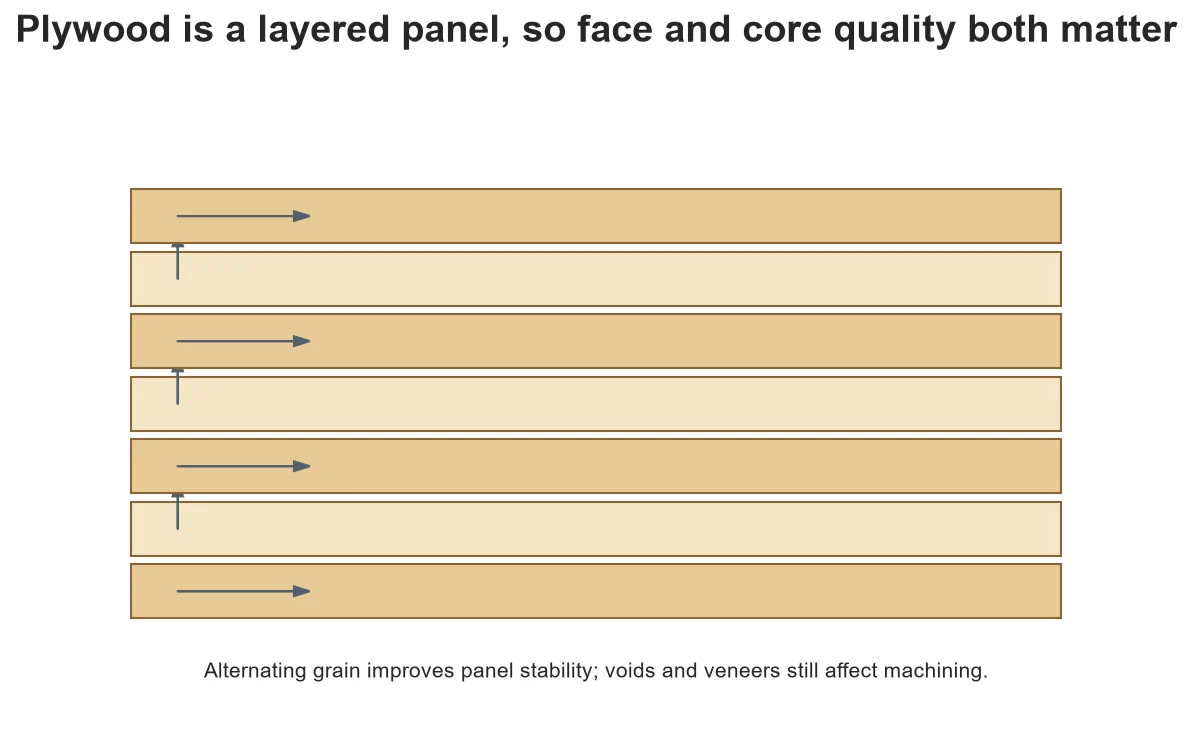
Plywood is not one uniform material. Two sheets with the same nominal thickness can differ in actual thickness, face veneer, glue, core gaps, flatness and internal repair. A CNC program only sees geometry, so the builder must translate these material differences into tool choice, allowance, workholding and inspection.
Read the panel from outside to inside
Face grade matters when a surface will remain visible, but a beautiful face does not guarantee a void-free core. Profiled edges expose gaps and patches that can weaken small tabs or spoil a clear finish. Inspect both faces, sheet edges and any available product specification. For joinery, test more than one location because internal construction can vary across a panel.
Thickness is a design input
Measure several points with suitable tools and note the range. Slot-and-tab furniture designed to a nominal 0.750 inch sheet may fit poorly when the actual panel is thinner or varies between sheets. Use parameterized CAD so slot width can be updated from a tested coupon. Do not compensate by forcing parts together; that can split veneers or distort the assembly.
Plan the visible face and cutting direction
Mark the show face, grain direction and sheet orientation before CAM. Downcut or compression geometry may protect a top veneer in suitable conditions, while chip evacuation and depth requirements still apply. Leave a finishing allowance when edge quality matters and support the panel so vibration does not tear the thin surface layer.
Control dust and fire risk
Plywood machining produces wood dust and may involve resins and coatings. Use effective source extraction, guarding and housekeeping appropriate to the machine and facility. OSHA identifies wood dust as a health hazard and fine accumulated dust as a fire concern. Do not use compressed air to spread settled dust into the workspace.
Buy for the project, not the label
Cabinet parts, painted signs and exposed furniture may need different panels. Record supplier, product, batch, measured thickness, face condition and machining result. A useful shop note says which operation was tested and how the edge was finished; simply writing birch plywood is not enough to reproduce the result.
Build a receiving check
Before material reaches the router, label the sheet and record supplier, product name, purchase date and measured thickness range. Sight along both diagonals for bow or twist, then mark damage and factory patches. This small receiving record separates a material change from a machine problem when a later job behaves differently.
Use one controlled test
Place a pocket, profile and representative joint on one coupon, using the same face orientation and finish strategy planned for the project. Photograph the edge, note fit by feel and keep the successful dimensions with the CAD revision. A coupon is useful only when its conditions can be traced.
Decision table
| Project need | Panel characteristic to prioritize | Verification |
| Visible furniture | Face veneer and flatness | Inspect both faces under raking light |
| Tab-and-slot assembly | Consistent actual thickness | Measure and cut fit coupon |
| Exposed profiles | Core quality and void control | Inspect edge and sample cut |
| Painted utility part | Stable panel and finish compatibility | Test machining and coating |
Worked situation
A flat-pack organizer fits in CAD but its slots are loose. Measure the actual sheet at several locations, cut a stepped slot coupon and update one material parameter in the model. If fit still varies, inspect thickness variation and veneer compression before applying a global tool-diameter offset.
Practical checklist
- Record actual thickness range.
- Identify show face and grain direction.
- Inspect core quality at an edge.
- Cut a fit and finish coupon.
Frequently asked questions
Is more ply always better?
Not by itself. Veneer quality, core construction, glue and manufacturing consistency also matter.
Can one plywood setting work for every supplier?
No. Treat a new product or batch as material requiring verification.
Should plywood be stored flat?
Support it to limit distortion and protect it from moisture conditions that can change flatness.
Sources and editorial use
Sources support the technical facts in this original explanation. Their text and images have not been republished.
- Wood Handbook: Wood as an Engineering Material — USDA Forest Products Laboratory
- Woodworking eTool: Wood Dust — U.S. Occupational Safety and Health Administration
- Woodworking eTool: Fire and Explosion — U.S. Occupational Safety and Health Administration