CNC Router Bits and Tool Selection · KB-035
O-Flute Router Bits for Plastic: Selection and Chip Control
Learn why O-flute geometry is used for suitable plastics and how chip evacuation, heat, workholding and material identity shape the setup.
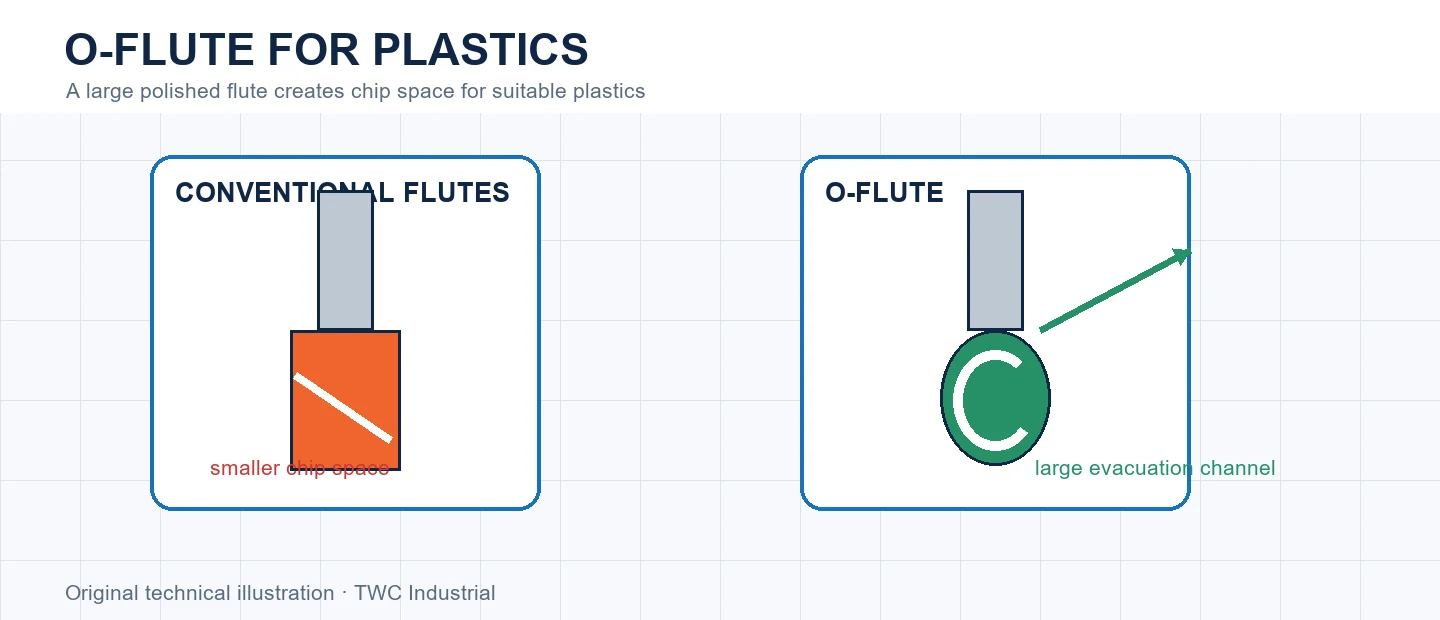
Many plastics soften when heat accumulates. O-flute cutters use a large polished flute intended to form and evacuate chips in suitable materials. Geometry helps, but it cannot compensate for rubbing, packed chips or an incorrectly identified plastic.
Understand the physical relationship
The open flute provides chip space and a cutting form used for many plastic-routing applications. Upcut or downcut variants affect evacuation and sheet forces differently. Manufacturer application data remains essential because plastics vary in hardness, reinforcement and softening behavior.
Connect geometry to the cut
Too little chip thickness can rub and heat the edge; poor evacuation can recut softened debris. Thin sheet may lift or vibrate, while protective film can wrap or melt. Entry, depth and direction interact with the chosen flute form.
Choose for the complete application
Verify material, cutter identity and film handling. Use effective chip removal and observe whether chips remain discrete instead of welding to the tool. Stop if material melts, smoke develops or extraction cannot control debris; do not touch a hot cutter.
Run a controlled comparison
Cut representative geometry in the intended material before committing valuable stock. Hold tool identity, projection, workholding and origin constant while changing one relevant variable. Record chips, sound, heat, edge condition and measured geometry. For o-flute router bits for plastic: selection and chip control, a completed path is not enough; the result must show that chips evacuate without welding and the sheet remains controlled. Keep the inspected coupon, photograph and CAM revision together.
Create a traceable tool record
Record manufacturer, part number, cutting diameter, shank, cutting length, flute form and measured projection. Add the tested material and operation rather than labeling the cutter only by color or drawer. Plastic identity and thermal behavior can make similar-looking sheets machine differently. Do not transfer an unexplained offset or operating value to a visually similar tool.
Interpret the evidence before changing CAM
If the cut differs from expectation, separate tool geometry from machine calibration, material variation, workholding and engagement. Measure more than one feature and inspect whether error changes with depth, direction or time. A consistent size offset suggests a different investigation from a mark repeating once per revolution or heat appearing only in corners. For this topic, plastic identity and thermal behavior can make similar-looking sheets machine differently. Correct the identified layer, repeat the controlled coupon and document the comparison instead of accumulating compensating settings whose purpose is no longer known.
Verify the full cutting envelope
Recalculate and simulate the cutter, shank and holder at the deepest feature, entry and retract. Confirm the physical tool matches the library and posted program. Review workholding, extraction, guarding and stop controls. A safe-looking centerline cannot prove the collet nut, dust shoe or released stock will remain clear.
Decision table
| Observation | Possible issue | Check |
| Welded debris | Heat or recutting | Chip formation |
| Sheet lift | Force/hold-down | Flute direction |
| Cloudy edge | Contact mismatch | Geometry |
| Clean chip | Encouraging | Still inspect size |
Worked situation
A clear sheet produces strings that wrap the cutter. Stop safely, verify the polymer and exact O-flute application, then review chip thickness and evacuation on a supported coupon.
Practical checklist
- Identify plastic.
- Confirm O-flute variant.
- Verify workholding.
- Inspect chips and heat.
Frequently asked questions
Is an O-flute only for one plastic?
No, but suitability and operating guidance depend on the exact cutter and material.
Can a tool-library entry replace cutter documentation?
No. Confirm the exact cutter identity and manufacturer limits, then verify imported values for the actual machine and setup.
Can appearance alone prove a cutter is safe?
No. Isolate power before handling and inspect according to the cutter, collet, spindle and machine manufacturers’ procedures.
Sources and editorial use
Sources support the technical facts in this original explanation. Their text and images have not been republished.
- CNC Router Bit Selection Poster — Amana Tool
- The Router Way: Tool Selection and Chip Load — LMT Onsrud
- Woodworking eTool: Routers — U.S. Occupational Safety and Health Administration