CNC Woodworking Project Foundations · KB-015
CNC Spoilboard Surfacing and Maintenance Guide
Create a usable reference plane, preserve vacuum performance and recognize when a CNC router spoilboard needs resurfacing or replacement.
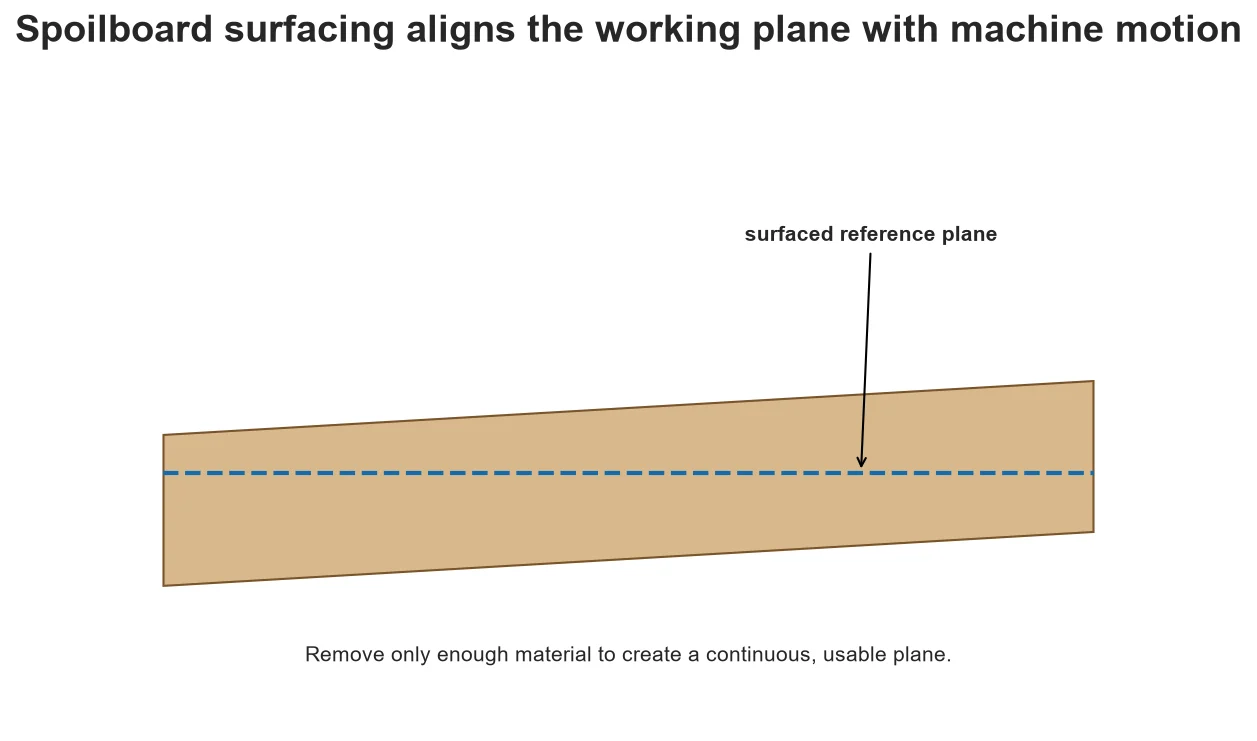
A spoilboard protects the machine bed and provides a sacrificial working surface. Surfacing makes that plane parallel to the router's XY motion, but only within the machine and setup conditions present during the operation. It does not repair a loose gantry or badly trammed spindle.
What surfacing establishes
The cutter sweeps a plane defined by axis motion. Removing high areas makes the spoilboard follow that plane, improving consistency for engraving, sheet cutting and Z touch-off. If the frame moves, the board swells or the machine is reassembled, the relationship can change.
Prepare before cutting
Remove screws and hidden metal from the path, verify hold-down, inspect the surfacing cutter and set a safe boundary inside clamps and table hardware. Use a tool and operating parameters supported by its manufacturer. Large cutters create significant load and dust; effective extraction and direct supervision are essential.
Recognize tram marks
Parallel ridges can appear when the spindle axis is not perpendicular to the travel plane. Taking deeper passes may make the board flat on average while leaving worse scallops. Diagnose ridge orientation and measure tram using an appropriate method before repeatedly removing material.
Vacuum spoilboards need system thinking
A porous board may distribute vacuum, while zones, seals and gasket paths control leakage. Surfacing can open the face and change flow, but excessive removal reduces life and may expose hardware. Clean without spreading combustible dust and verify holding force on representative parts after maintenance.
Create replacement criteria
Track surfaced date, cutter, depth removed, remaining thickness, ridge condition and vacuum behavior. Replace a board when damage, thinness, embedded contamination or sealing problems make it unreliable. Avoid waiting for a cutter to reach table hardware.
Measure before removing material
A surfacing pass can make the spoilboard parallel to machine motion, but it cannot correct every frame, rail or spindle problem. Map several points first and look for a repeatable pattern. If the error changes after warming, loading or moving the machine, investigate that behavior before repeatedly cutting the board lower.
Preserve the spoilboard as a reference
After surfacing, clean the system and record the cutter, overlap, depth, date and resulting usable thickness. Mark fixture holes or zones that must not be crossed. When the board approaches its replacement limit, replace it deliberately rather than allowing screws, inserts or vacuum features to enter the toolpath.
Decision table
| Symptom | Possible cause | First check |
| Depth varies across table | Spoilboard plane, frame or stock | Measure reference grid |
| Regular surfacing ridges | Spindle tram or cutter condition | Check ridge direction and tram |
| Vacuum weak after routing | Leaks, zones, porosity or small area | Test sealed representative setup |
| Profiles leave inconsistent onion skin | Plane, sheet thickness or stock warp | Map board and sheet |
Worked situation
A V-carved sign is deeper on the left. Surface a small reference only after verifying that the gantry and stock are stable. If the spoilboard maps flat but the sign still varies, inspect sheet warp, workholding and Z-zero procedure instead of removing more spoilboard.
Practical checklist
- Remove path hazards and hardware.
- Verify cutter and extraction.
- Check tram and machine condition.
- Record removed depth and remaining thickness.
Frequently asked questions
How often should a spoilboard be surfaced?
When measurement or damage shows the working plane no longer meets the job, not merely on a calendar.
Does surfacing square the spindle?
No. It follows the cutter sweep and can reveal tram error as ridges.
Can any MDF be a vacuum spoilboard?
Material permeability and system design matter; follow the table manufacturer's guidance.
Sources and editorial use
Sources support the technical facts in this original explanation. Their text and images have not been republished.
- Woodworking eTool: Wood Dust — U.S. Occupational Safety and Health Administration
- Woodworking eTool: Fire and Explosion — U.S. Occupational Safety and Health Administration
- 10 Milling Toolpaths for Your First 2D CNC Machining Project — Autodesk Fusion