CNC Toolpaths and Cutting Operations · KB-029
CNC Toolpath Order: A Practical Sequence for Reliable Parts
Order facing, drilling, pockets, engraving and profiles so references, rigidity, workholding and tool changes remain controlled.
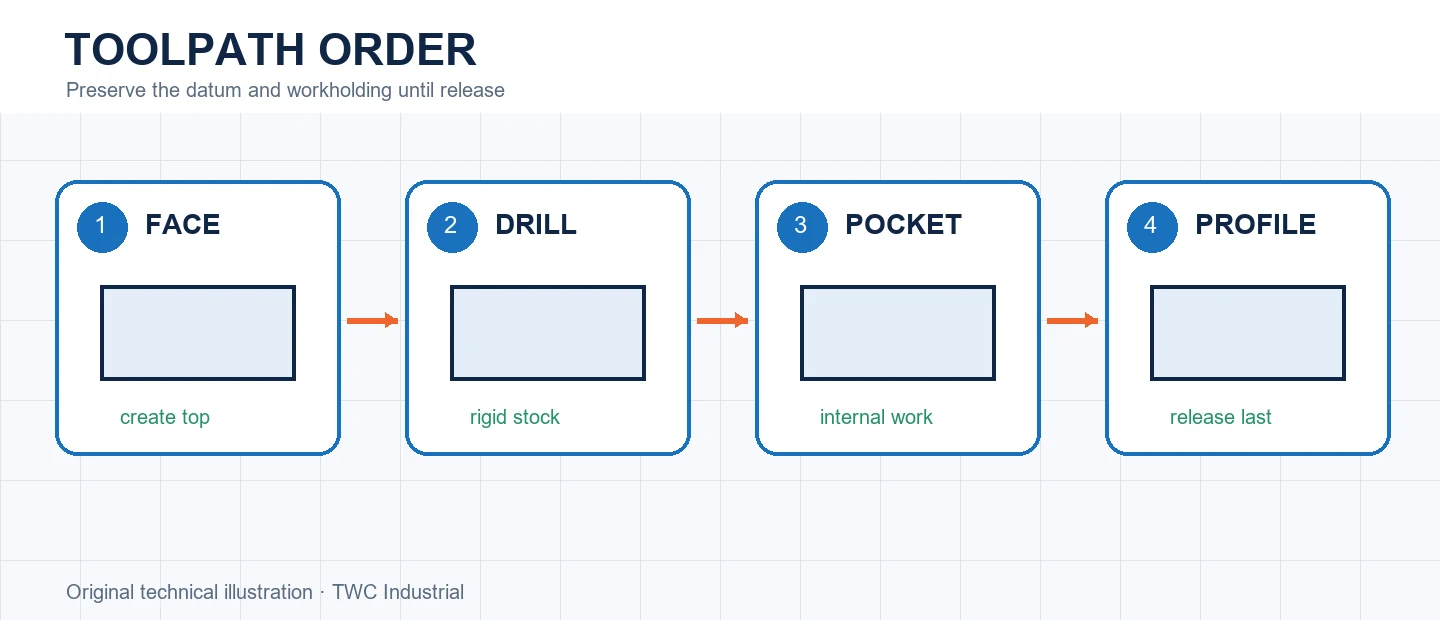
A set of correct operations can still fail in the wrong order. Cutting an outside profile early may release the part before its holes are drilled. Surfacing after engraving may erase the detail. Sequence should preserve reference surfaces, stiffness and hold-down until each dependent operation is complete.
Map dependencies first
Write what each operation needs: an intact top, a fixed outer boundary, a flat fixture or an existing pocket. Then note what it destroys. This simple dependency map is more reliable than sorting only by tool number.
Do internal work before release
Drilling, pockets and engraving are commonly completed while the surrounding stock still supports the part. Exceptions exist when a prior operation creates a required datum or access. Review small islands and offcuts that may become loose during any stage.
Group tools carefully
Reducing tool changes saves time and avoids repeated length setup, but moving an operation earlier can sacrifice rigidity. If grouping is safe, recalculate all affected paths and confirm that each path understands the stock left by previous tools.
Run a controlled comparison
Create a small test that reproduces the important geometry from this operation before applying it to a full sheet or valuable blank. Keep the tool, projection, stock, workholding and origin unchanged while comparing one setting at a time. Inspect dimensions, edge condition, floor or wall marks, chips, heat and any movement. In cnc toolpath order: a practical sequence for reliable parts, the useful result is not simply that the program completed; it is evidence showing why one setup behaved better. Retain the test file, photograph and measurement with the CAM revision. If the outcome varies, investigate each operation changes the stock available to every later operation. before creating a compensating number that hides the cause.
Turn the setting into a shop record
Save the CAM strategy, tool identity, measured stock, origin, workholding and postprocessor with the result. Record what was inspected and what changed. A screenshot of one dialog is incomplete because each operation changes the stock available to every later operation. Reproducibility comes from the complete setup, not a remembered number.
Verify before committing the workpiece
Recalculate and simulate after every material change. Review the cutter, holder, rapid moves, retracts, remaining stock and order of operations. When appropriate, perform a controlled verification away from the work before cutting. Stop for unexpected sound, movement, heat, dust escape or a path that does not match the preview.
Decision table
| Operation | Often early because | Dependency to check |
| Facing | Creates controlled top | Enough stock remains |
| Drilling | Benefits from rigid sheet | Breakthrough support |
| Pocketing | Keeps outer frame | Island retention |
| Profile | Releases final part | All dependent work complete |
Worked situation
A panel shifts while its final holes are drilled because the outside profile ran first. Move drilling before release, retain sufficient support and verify breakthrough into sacrificial material. Tool-change convenience is secondary to stable workholding.
Practical checklist
- List operation dependencies.
- Mark when parts become free.
- Preserve datums and rigidity.
- Simulate stock after each operation.
Frequently asked questions
Should profiling always be last?
Often, but not universally. Fixtures, two-sided work and required access can justify another sequence.
Can simulation prove that a toolpath is safe?
No. It can reveal geometry and sequencing problems, but it cannot prove workholding strength, machine condition, tool retention or extraction performance.
Should a new operation begin at production speed?
Use documented tool guidance and a controlled verification appropriate to the machine, material and setup. Keep the first run under direct supervision.
Sources and editorial use
Sources support the technical facts in this original explanation. Their text and images have not been republished.
- 10 Milling Toolpaths for Your First 2D CNC Machining Project — Autodesk Fusion
- Vectric 2D Profile Toolpath — Vectric
- Woodworking eTool: Routers — U.S. Occupational Safety and Health Administration