CNC Router Fundamentals · KB-004
Trim Router vs CNC Spindle: What Actually Changes?
Compare speed control, duty cycle, noise, tool holding, torque, wiring and cooling before choosing a trim router or CNC spindle.
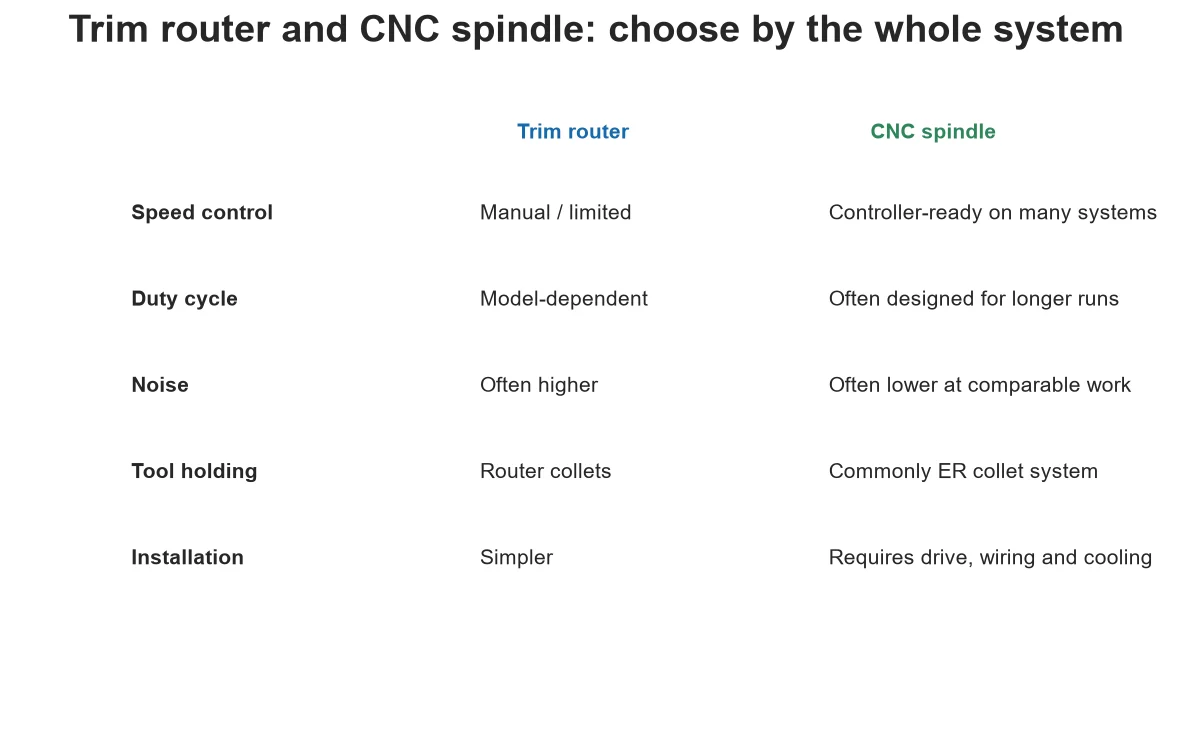
A trim router can be a sensible entry point, while a purpose-built spindle can improve control and long-run behavior. The better choice depends on the entire machine, expected work and electrical installation—not on spindle power printed in an advertisement.
Control and integration
Many trim routers use local speed control and separate switching. Many CNC spindles use a variable-frequency drive that can accept controller commands. Integration adds wiring, configuration, grounding and electromagnetic-noise considerations.
Mechanical behavior
Check bearing quality, runout, allowable tool sizes, mass and mounting diameter. A heavier spindle may exceed what a light Z axis can accelerate or support without flex.
Cooling and duty
Air-cooled and water-cooled spindles manage heat differently. A water loop adds pump, hoses and leak management. Neither design should be assumed suitable for unlimited duty without its manufacturer's ratings.
A practical decision
Choose from real jobs: material, cutter diameter, target speed, run time, noise limits and required controller automation. Then confirm electrical supply, drive compatibility and machine capacity.
Compare the speed range at the cutter you will actually use
A spindle advertised at a high maximum speed may still be a poor match if the job needs useful torque at lower speed. A trim router may have a narrower controllable range and manual settings, while a VFD spindle may support command control and smoother integration. Build a job list with cutter diameters, materials and expected run duration, then compare those requirements with manufacturer curves and limits. Do not infer torque from electrical power alone, and do not assume that entering a lower RPM in CAM makes an uncontrolled router run at that speed.
Include the installation around a VFD
A VFD spindle is not just a motor purchase. The system can require a compatible drive, supply circuit, shielded motor cable, grounding, control interface, enclosure, cooling components and parameter setup. Poor installation can create electrical noise that disturbs probes, switches or communication. Safety-rated stopping and isolation are separate design questions from ordinary speed commands. Electrical work should follow applicable instructions and be performed by a qualified person where required.
Count the mechanical cost on the Z axis
A heavier spindle increases the static load and the mass the Z axis must accelerate. The mount must fit without reducing useful travel or colliding with the gantry. Added weight can reveal backlash, flex or motor limits that were not obvious with a trim router. Check mount diameter, body length, collet access, cable bend radius, cooling-hose routing and dust-shoe compatibility. The upgrade is successful only when the machine can position and support it throughout the full work envelope.
Choose by operating pattern
A light-duty machine used for short plywood jobs may benefit more from good tooling, extraction and workholding than from an immediate spindle conversion. A production machine running long cycles may value controller speed commands, lower noise and an appropriate duty design. Education shops may prioritize simple inspection and replacement. Record the decision criteria so a later upgrade is based on changed requirements rather than a general belief that a spindle is always superior.
Decision table
| Decision factor | Trim router | CNC spindle |
| Entry complexity | Usually simpler | Drive, wiring and controls required |
| Speed command | Often local/manual | Often controller-compatible through VFD |
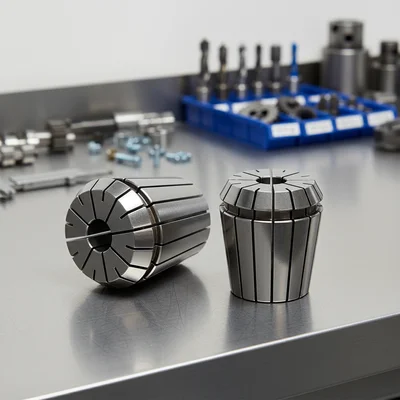
| Tool holding | Router-specific collets | Commonly ER system; verify sizes |
| Cooling | Integrated air path | Air- or water-cooled system |
| Z-axis load | Often lighter | May require capacity and mount review |
| Long-cycle suitability | Model-specific | Model and cooling-system specific |
Worked situation
A small router owner wants to cut occasional aluminum plates. Replacing the trim router does not automatically solve chatter. First audit runout, tool projection, Z stiffness, workholding, chip evacuation and usable feed/speed range. If the existing motor cannot operate appropriately after those constraints are controlled, the audit supplies real spindle requirements.
Practical checklist
- List required cutter shank sizes.
- Check spindle mass against Z-axis capacity.
- Confirm supply voltage and current.
- Plan speed control, stop behavior and cooling.
Frequently asked questions
Is a spindle always more accurate?
No. Accuracy depends on spindle construction, collet condition, mounting and the rest of the machine.
Does higher power improve small-tool cutting?
Not automatically. Small tools are often limited by runout, chip evacuation, rigidity and appropriate feed.
Can software control any VFD?
Only when the controller, interface and VFD support compatible signals and are configured safely.
Sources and editorial use
Sources support the technical facts in this original explanation. Their text and images have not been republished.
- Speeds and Feeds for New CNC Machinists — Autodesk Fusion
- Woodworking eTool: Routers — U.S. Occupational Safety and Health Administration