CNC Router Fundamentals · KB-003
CNC Homing, Limit Switches and Soft Limits Explained
Understand hard stops, limit switches, home switches and software travel limits before configuring or operating a CNC router.
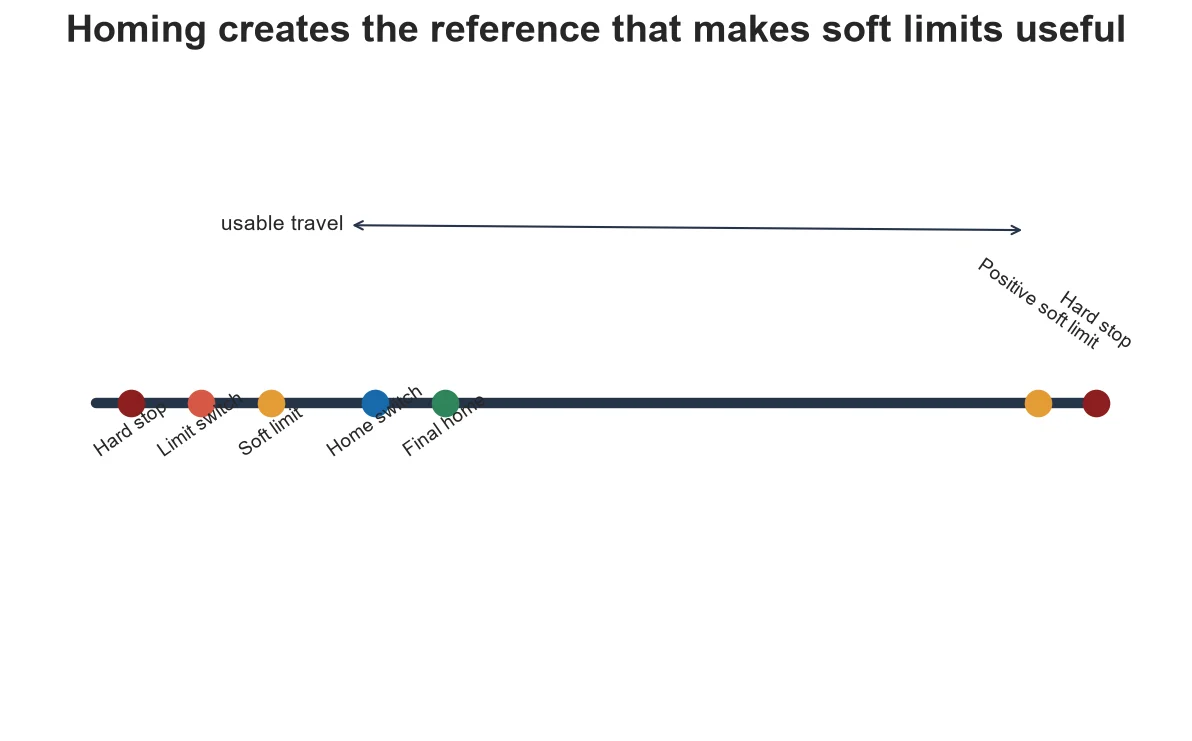
Homing and limiting are related but not identical. Homing finds a repeatable reference. Limit hardware detects travel boundaries. Soft limits use the known reference to reject commanded motion before the machine reaches its physical end.
Four boundaries to distinguish
The hard stop is the physical end. A limit switch is placed before it. A soft limit is configured inside the protected range. The final home position is a deliberate location reached after the reference event.
What homing does
A homing sequence searches for a known event, may back off and approach again more slowly, assigns machine coordinates and moves to a configured home position. Gantry machines may need independent joint homing to square the bridge.
Shared and separate switches
Some systems share a home and limit input; others use separate devices. The electrical logic, debounce, failure mode and controller configuration must agree. Copying another machine's settings without checking direction can cause a crash.
Testing without committing
Remove the cutting tool, reduce speed, keep a hand near stop controls and test one axis at a time. Verify input state manually, search direction, latch behavior, final position and both soft limits.
Understand the sequence, not only the switch
A typical switch-based sequence searches at a controlled speed, detects the input, reverses to clear it, approaches again at a slower latch speed, assigns a known coordinate and moves to a final home position. Controllers differ, and gantry joints can require a coordinated sequence. Search velocity, direction, latch behavior and offset must agree with switch placement. If one setting has the wrong sign, the joint may travel away from the switch. Test configuration with tooling removed and motion speeds reduced according to the controller and machine procedures.
Design for faults as well as normal operation
A switch circuit can fail open, fail closed, bounce or become mechanically misaligned. Normally closed wiring is often chosen because a broken wire changes the monitored state, but the complete control design determines whether that provides useful detection. Inputs also need stable electrical reference and suitable noise control. Do not defeat a persistent limit indication merely to resume production. Identify whether the axis is on the switch, the input logic is inverted, wiring has failed or the controller state is wrong.
Measure homing repeatability
Home repeatedly from different starting positions, then measure a fixed reference with an indicator or probe. Record the spread rather than reporting one successful cycle. Repeatability depends on switch type, approach direction, latch speed, mechanics and temperature. The result should be suitable for how the machine uses home: basic soft-limit protection may tolerate more variation than automated fixture recovery. If a gantry squares during homing, also measure diagonal or joint alignment rather than checking only one axis coordinate.
Decision table
| Layer | Purpose | Failure concern |
| Hard stop | Physical end of travel | Mechanical damage |
| Limit switch | Detect boundary | Coasting distance, wiring or alignment |
| Soft limit | Reject commanded overtravel | Invalid until machine reference is known |
| Home switch/event | Establish repeatable reference | Direction and repeatability |
Worked situation
If an axis homes successfully but later reaches a soft limit too early, measure actual available travel and review machine-zero assignment, HOME_OFFSET and configured minimum/maximum values. Moving the soft limit without understanding the reference can remove protection rather than recover usable travel.
Practical checklist
- Verify switch state before motion.
- Confirm search direction for each joint.
- Leave physical stopping margin.
- Test soft limits after homing.
Frequently asked questions
Can a CNC run without home switches?
Some controllers allow manual homing, but repeatability and the protection offered by soft limits are reduced.
Are limit switches emergency stops?
They are part of travel protection, not a replacement for an emergency-stop system and risk assessment.
Why move away after finding home?
The final home position can place the axis safely inside its usable range and off the switch.
Sources and editorial use
Sources support the technical facts in this original explanation. Their text and images have not been republished.
- LinuxCNC Stepper Configuration Wizard — LinuxCNC
- LinuxCNC Important User Concepts — LinuxCNC