CNC Toolpaths and Cutting Operations · KB-021
CNC Pocket vs Adaptive Clearing: Which Strategy Fits the Job?
Compare conventional pocket clearing with adaptive toolpaths by engagement, entry method, remaining stock, machine limits and finishing needs.
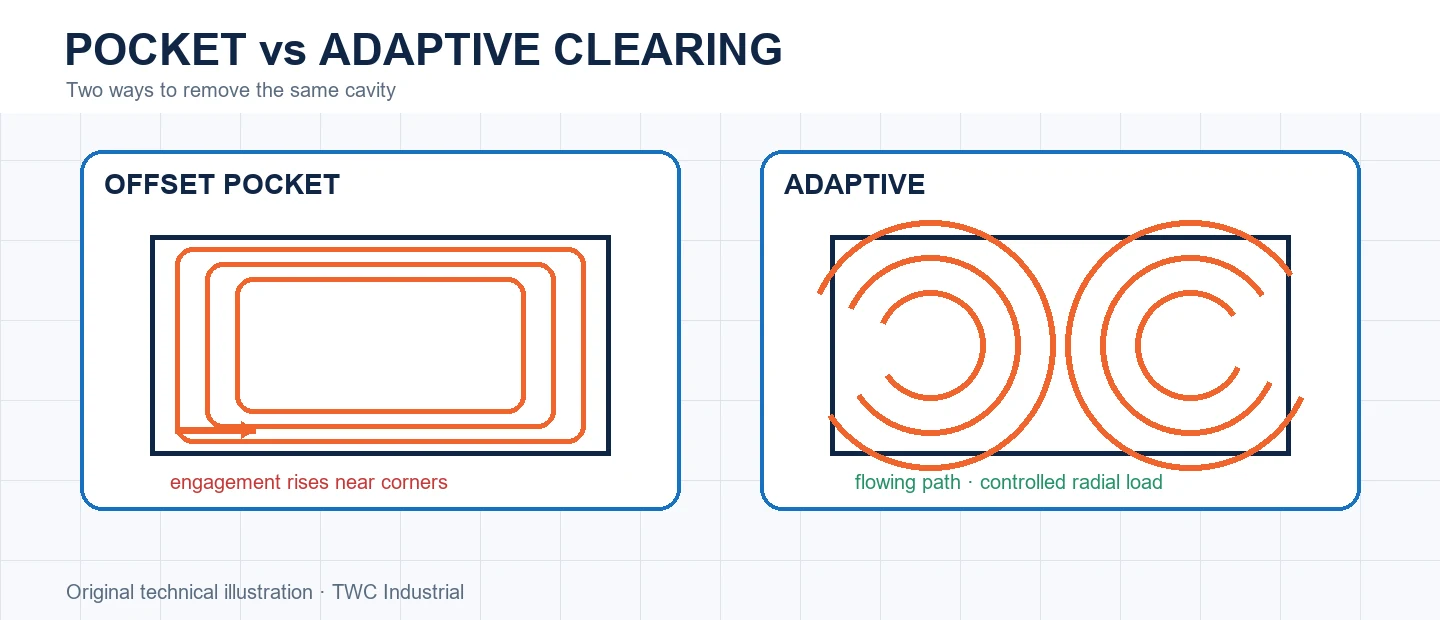
Pocket and adaptive clearing can remove material from the same boundary, but they manage cutter engagement differently. The useful question is not which name sounds advanced; it is which strategy produces a verifiable load, reachable geometry and sensible finish plan on the actual router.
How the paths differ
A traditional pocket often follows repeated offsets or a raster pattern. Engagement changes near corners and narrow regions. Adaptive clearing uses a flowing path intended to control radial engagement more consistently and avoid abrupt direction changes. Its optimal-load value still needs an appropriate tool, depth and machine response.
Check what the cutter can reach
Neither strategy can remove material from a corner smaller than the cutter radius. Preview remaining stock around islands, narrow channels and sharp internal features. A smaller cleanup tool may be more efficient than forcing one large tool to reach everything.
Separate removal from finish
Leave intentional stock on walls or floors when a finish pass is planned. Roughing seeks reliable removal; finishing seeks controlled contact and final dimension. Combining both goals in one aggressive pass makes diagnosis difficult when the wall is tapered or the surface shows witness marks.
Run a controlled comparison
Create a small test that reproduces the important geometry from this operation before applying it to a full sheet or valuable blank. Keep the tool, projection, stock, workholding and origin unchanged while comparing one setting at a time. Inspect dimensions, edge condition, floor or wall marks, chips, heat and any movement. In cnc pocket vs adaptive clearing: which strategy fits the job?, the useful result is not simply that the program completed; it is evidence showing why one setup behaved better. Retain the test file, photograph and measurement with the CAM revision. If the outcome varies, investigate strategy settings interact with geometry, engagement and entry. before creating a compensating number that hides the cause.
Turn the setting into a shop record
Save the CAM strategy, tool identity, measured stock, origin, workholding and postprocessor with the result. Record what was inspected and what changed. A screenshot of one dialog is incomplete because strategy settings interact with geometry, engagement and entry. Reproducibility comes from the complete setup, not a remembered number.
Verify before committing the workpiece
Recalculate and simulate after every material change. Review the cutter, holder, rapid moves, retracts, remaining stock and order of operations. When appropriate, perform a controlled verification away from the work before cutting. Stop for unexpected sound, movement, heat, dust escape or a path that does not match the preview.
Decision table
| Condition | Pocket may suit | Adaptive may suit |
| Shallow open area | Simple predictable offsets | Possible but not always necessary |
| Deep cavity | Review corner engagement | Controlled radial load may help |
| Tight details | Cleanup tool required | Cleanup tool still required |
| Final wall | Use finish contour | Use separate finish contour |
Worked situation
A rectangular recess cuts cleanly on its long sides but chatters in corners. Rather than reducing the feed everywhere, inspect how engagement rises at each turn. Test an adaptive roughing path with documented load, leave wall stock and compare the separate finish contour.
Practical checklist
- Identify roughing and finishing goals.
- Inspect entry and maximum engagement.
- Preview remaining stock.
- Verify holder and evacuation clearance.
Frequently asked questions
Is adaptive always faster?
No. Calculation, extra motion, machine acceleration and geometry all affect elapsed time and result.
Can simulation prove that a toolpath is safe?
No. It can reveal geometry and sequencing problems, but it cannot prove workholding strength, machine condition, tool retention or extraction performance.
Should a new operation begin at production speed?
Use documented tool guidance and a controlled verification appropriate to the machine, material and setup. Keep the first run under direct supervision.
Sources and editorial use
Sources support the technical facts in this original explanation. Their text and images have not been republished.
- 2D Adaptive Clearing Reference — Autodesk Fusion
- 10 Milling Toolpaths for Your First 2D CNC Machining Project — Autodesk Fusion
- Woodworking eTool: Routers — U.S. Occupational Safety and Health Administration