CNC Router Fundamentals · KB-008
Climb vs Conventional Cutting on a CNC Router
Understand how cutter rotation and feed direction change chip formation, machine load and edge finish in climb and conventional cutting.
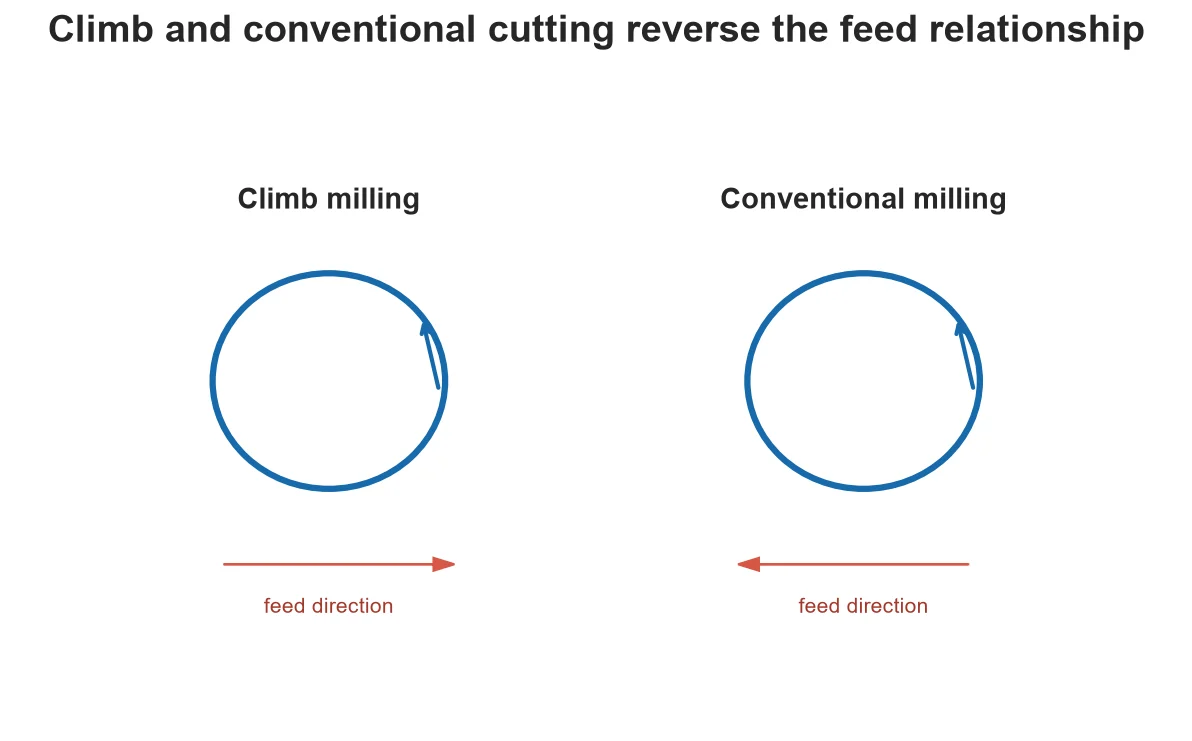
Climb and conventional milling describe the relationship between cutter rotation and feed at the cutting edge. The difference changes how chip thickness develops and how force acts on the machine and stock.
Chip formation
In a simplified view, climb cutting begins with a thicker chip and exits thinner; conventional cutting begins thin and grows thicker. This changes rubbing, force direction and the marks left on an edge.
Machine behavior
Climb cutting can pull the cutter into the work. Backlash or weak workholding makes that dangerous. Modern CNC systems with controlled axes often use climb cutting, but the assumption must match the actual machine condition.
Inside and outside profiles
The same clockwise toolpath can represent a different cutting mode on an inside boundary than on an outside boundary. CAM labels and simulation are safer than memorizing one direction rule without context.
Use finishing passes deliberately
A light, controlled finish pass may improve consistency, but too little material can cause rubbing. Leave intentional stock and apply a direction supported by the material, tool and machine.
Determine direction from the engaged edge
Looking down on a clockwise-rotating cutter, an outside contour and an inside pocket engage opposite sides of the tool for the same path direction. That is why memorizing clockwise equals climb is incomplete. Identify which side of the boundary remains as the finished surface, mark cutter rotation and inspect the relative motion at contact. CAM systems normally offer a climb or conventional setting; verify the generated arrows and simulation instead of rewriting paths by intuition.
Relate force direction to backlash and workholding
Climb cutting tends to pull the cutter into the work and can draw an axis through mechanical clearance if backlash is present. Conventional cutting tends to oppose feed differently but may rub more at entry. On a controlled CNC router, climb is often used, yet a loose rack, worn nut or weak fixture changes the risk. Check machine condition and consider how the cutting force pushes the part relative to clamps, vacuum zones or tabs.
Use material behavior as evidence
Wood grain, laminated faces and brittle plastics can respond differently on opposite edges. A direction that produces a clean edge on one side may lift fibers on the other. Use representative test geometry that contains inside and outside edges, and label direction on the result. Compare finish, dimension and tool behavior while keeping tool, engagement and feed constant. One sample cannot establish a universal rule, but it gives local evidence for the actual material batch and setup.
Decision table
| Consideration | Climb tendency | Conventional tendency |
| Chip thickness | Thicker at entry, thinner at exit | Thinner at entry, thicker at exit |
| Axis clearance | Can pull into mechanical play | Loads the opposite relationship |
| Common CNC use | Frequently selected on rigid systems | Useful in specific material/setup cases |
| Decision method | Verify CAM and test finish | Verify CAM and test finish |
Worked situation
If an outside profile has one rough side, do not reverse every path immediately. Mark grain direction, cutter rotation and feed direction, then cut two small coupons with controlled climb and conventional finish passes. The comparison separates direction effects from a damaged flute or loose stock.
Practical checklist
- Confirm spindle rotation.
- Identify the engaged side of the cutter.
- Verify workholding against force direction.
- Simulate inside and outside boundaries.
Frequently asked questions
Is climb always better?
No. It is common on suitable CNC machines, but backlash, material behavior and workholding affect the choice.
Why did one edge finish better?
Grain, cutter geometry, entry and cutting direction can change edge behavior.
Can one toolpath contain both modes?
Some strategies can, particularly complex or bidirectional paths. Review CAM behavior.
Sources and editorial use
Sources support the technical facts in this original explanation. Their text and images have not been republished.
- 10 Milling Toolpaths for Your First 2D CNC Machining Project — Autodesk Fusion
- Speeds and Feeds for New CNC Machinists — Autodesk Fusion