CNC Condition Monitoring
Before Modeling: Audit CNC Label Coverage
Learn why uneven good/bad coverage across machines and operations changes what a CNC dataset can support.
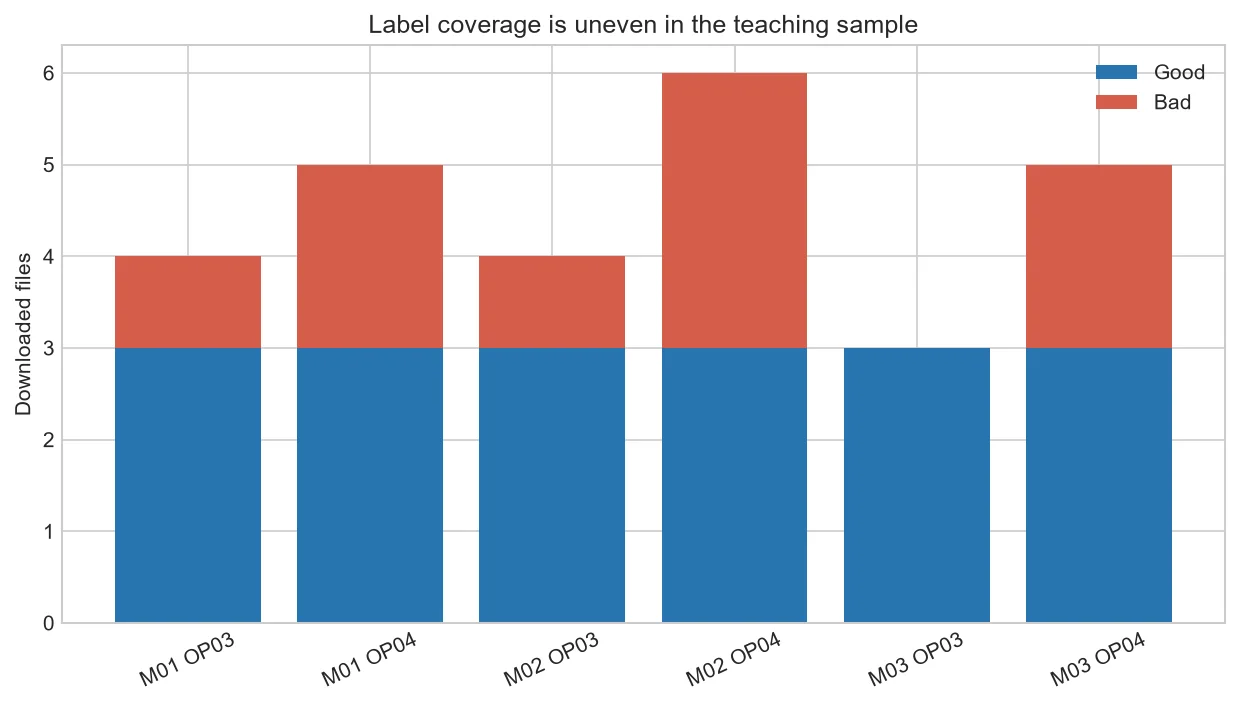
A model cannot learn evidence that the dataset does not contain. Before choosing an algorithm, count files by machine, operation, date and label.
Read absence correctly
No downloaded bad file for one group does not mean that operation never becomes anomalous. It means this teaching subset lacks that evidence.
Coverage shapes the question
A group with only healthy files can support baseline exploration but not supervised good/bad evaluation.
Count dates as well as files
Many files from one session may provide less diversity than fewer files from several periods.
Build a coverage table
Track machine, operation, label, date, duration and acquisition settings before modeling.
Turn inventory into an analysis plan
Mark each machine-operation group as baseline-only, labeled comparison or insufficient. Choose a method that fits the strongest evidence instead of forcing every group into classification.
For sparse anomalies, consider one-class monitoring trained on healthy data, but validate it on whatever independent abnormal evidence exists.
| Coverage | Suitable use |
| Healthy only | Baseline and novelty monitoring |
| Both labels | Supervised comparison |
| Very few files | Exploration only |
Common mistakes to avoid
- Treating missing labels as zeros.
- Counting files without dates.
- Balancing by duplicating rare files before splitting.
Frequently asked questions
Is more data always better?
Only when it adds representative variation and reliable labels.
Can unlabeled files help?
Yes for representation and baseline studies, with careful assumptions.
Should sparse groups be deleted?
Not automatically; state their limited role.
Practical workflow for this method
Generate an inventory automatically during every dataset update. A coverage change can invalidate an old evaluation split.
Preserve file-level provenance so every chart and model result can be traced back to exact records.
Add an analysis-eligibility field to the inventory. A group may support healthy-baseline charts but not supervised classification. This prevents code from treating missing classes as valid evidence.
Review labels with domain knowledge where possible. Production deployment needs the event definition, inspection evidence and uncertainty, not only a filename annotation.
A useful inventory script should produce one row per file with machine, operation, label, date, duration, channel count and quality status. Pivot tables can then expose empty or weak groups before any model is trained. Save the inventory with the analysis so later results remain reproducible.
Define minimum evidence for each claim. A descriptive chart may need only a few clearly identified examples, while an estimated threshold or classification score needs broader independent data. The article or report should state which level it reaches.
About the data used in this guide
The charts use a small teaching sample selected from machines M01, M02 and M03, primarily operations OP03 and OP04. The source records tri-axial acceleration at 2 kHz and labels available examples as good or bad. Label coverage is uneven across machine-operation groups, so missing groups are not treated as healthy evidence. These figures are transparent worked examples, not population estimates or universal fault thresholds.
Dataset: CNC Machining Data, CC BY 4.0. Recommended citation: Tnani, Mohamed-Ali; Feil, Michael; Diepold, Klaus. Smart Data Collection System for Brownfield CNC Milling Machines: A New Benchmark Dataset for Data-Driven Machine Monitoring. Procedia CIRP 107 (2022), 131–136. Research paper.
We explain what the selected data supports and avoid naming a mechanical fault when the dataset only provides a good/bad process label. A machine should be inspected by a qualified person before maintenance or safety decisions are made.