CNC Condition Monitoring
Kurtosis in CNC Vibration Monitoring: Useful, but Easy to Misread
Understand what vibration kurtosis measures, why small samples exaggerate it and how to use it with CNC process context.
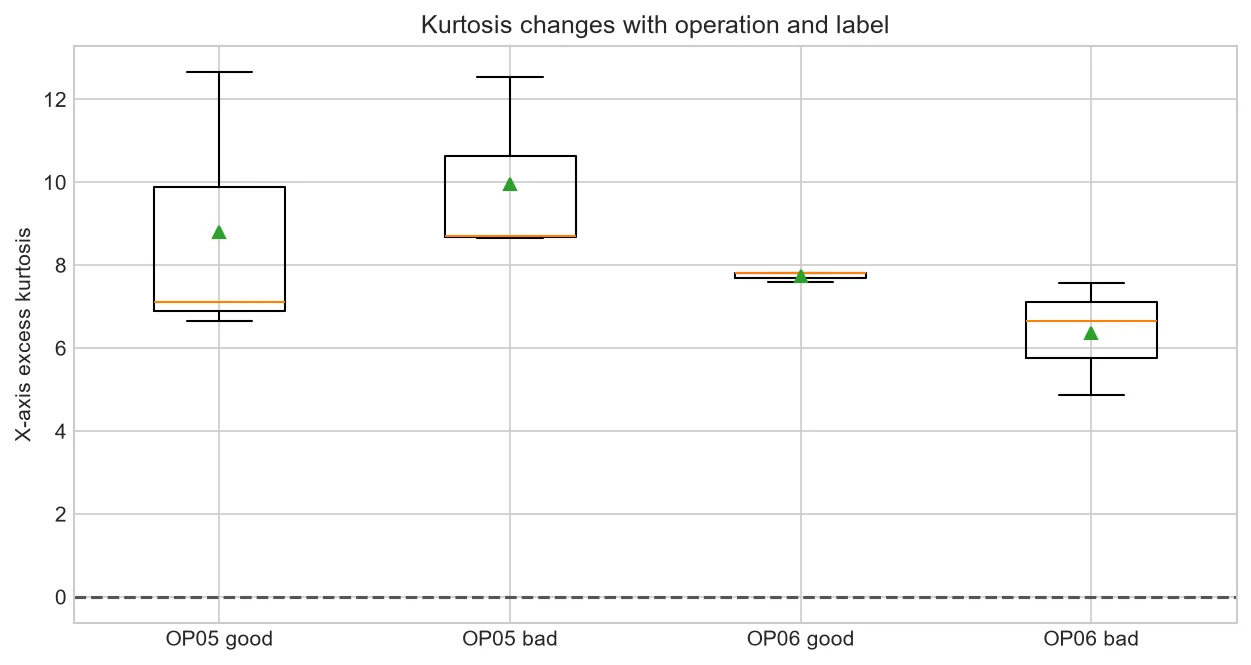
Kurtosis summarizes how strongly a distribution is influenced by extreme values. In vibration work it is often used as an impulsiveness feature, yet it does not identify the mechanical source of those impulses.
What the number means
A waveform with occasional large deviations can have higher kurtosis than a smoother waveform with similar RMS. Software packages use different conventions, so a normal distribution may be reported as three or zero.
Why sample length matters
Extreme-value statistics vary strongly in short windows. Comparing a two-second file with a twenty-second file without standardization can create an apparent condition difference caused by duration.
Process impacts are real too
Tool entry, chip strikes and programmed motion can increase kurtosis in a healthy operation. Compare the same machine, operation and phase before assigning maintenance meaning.
Use it as supporting evidence
A persistent kurtosis rise is more persuasive when it coincides with changes in RMS, crest factor, spectrum or inspection findings.
Build a repeatable kurtosis trend
Divide each aligned cycle into fixed phases and calculate excess kurtosis per axis. Trend medians and ranges across healthy dates before defining a review band.
On an alert, save the contributing window and highlight its largest samples. This lets an engineer see whether the statistic arose from a physical impact, clipping or noise.
| Question | Required control |
| Is it changing? | Same window and phase |
| Is it impulsive? | Raw waveform review |
| Is it mechanical? | Process and inspection context |
Common mistakes to avoid
- Mixing kurtosis definitions.
- Using unequal record lengths.
- Assigning a fault from kurtosis alone.
Frequently asked questions
Is higher always worse?
No; healthy cutting phases may be naturally impulsive.
Can one spike dominate?
Yes, which is why waveform review matters.
Should kurtosis be normalized?
The statistic is dimensionless, but the compared process population still must be controlled.
Practical workflow for this method
Report estimator choice and bias correction because packages can disagree on small samples.
Test robustness by removing or winsorizing the largest sample for diagnosis only; a large change reveals that one event dominates the result.
About the data used in this guide
The charts use a small teaching sample selected from machines M01, M02 and M03, primarily operations OP05 and OP06. The source records tri-axial acceleration at 2 kHz and labels available examples as good or bad. Label coverage is uneven across machine-operation groups, so missing groups are not treated as healthy evidence. These figures are transparent worked examples, not population estimates or universal fault thresholds.
Dataset: CNC Machining Data, CC BY 4.0. Recommended citation: Tnani, Mohamed-Ali; Feil, Michael; Diepold, Klaus. Smart Data Collection System for Brownfield CNC Milling Machines: A New Benchmark Dataset for Data-Driven Machine Monitoring. Procedia CIRP 107 (2022), 131–136. Research paper.
We explain what the selected data supports and avoid naming a mechanical fault when the dataset only provides a good/bad process label. A machine should be inspected by a qualified person before maintenance or safety decisions are made.