CNC Condition Monitoring
What a 2 kHz Sampling Rate Means for CNC Vibration Data
Understand samples per second, the 1 kHz Nyquist limit, aliasing, and how to choose a useful sampling rate.
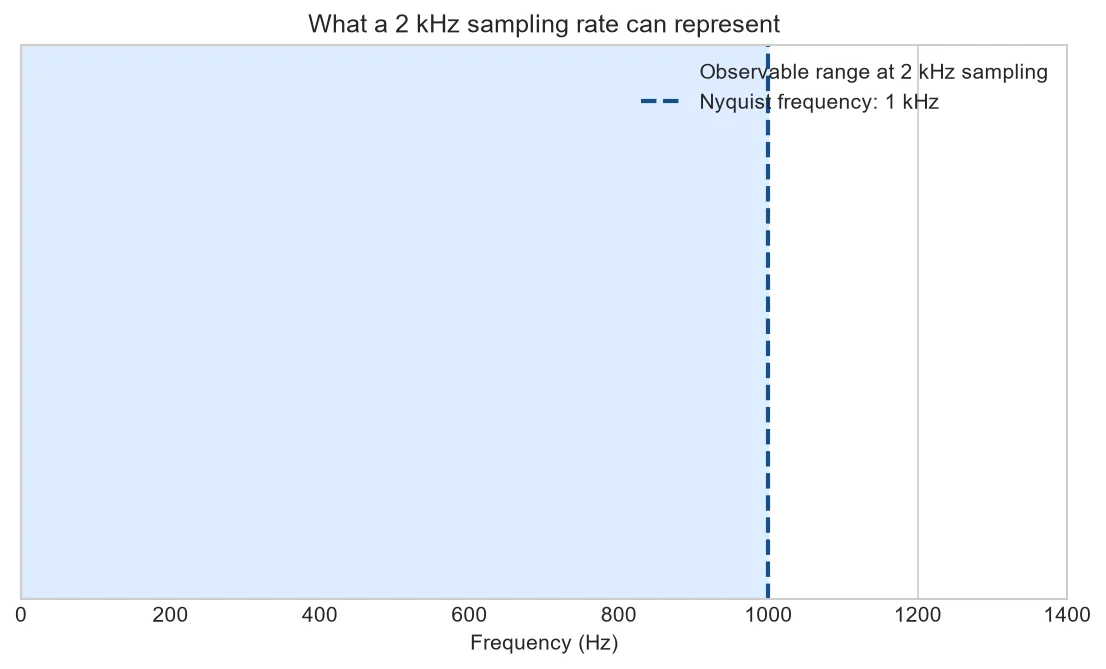
Sampling rate tells you how often the measurement system takes a reading. At 2 kHz, the sensor produces 2,000 readings per second for each axis. More samples reveal faster motion, but they also create more data.
From time to frequency
A repeating vibration at 100 Hz completes 100 cycles each second. To reconstruct it, the system needs multiple measurements within each cycle. The Nyquist rule sets an absolute theoretical minimum of two samples per cycle, but real measurements normally need margin.
What aliasing looks like
A frequency above the measurable range can fold back and appear as a false lower frequency. This is aliasing. It cannot be repaired reliably after collection, which is why measurement hardware uses an anti-alias filter before digitizing the signal.
Is 2 kHz enough?
It can be useful for many process-monitoring patterns, but it is not automatically enough for every bearing or high-frequency impact study. Required bandwidth depends on spindle speed, tooth-pass frequencies, bearing geometry, structure, and sensor response.
Avoid collecting data without a question
A very high sample rate increases storage and processing cost. Define the phenomenon you want to detect, estimate its frequency range, check the sensor specification, and then choose a rate with appropriate filtering and margin.
Turning sample rate into practical numbers
At 2,000 samples per second, a one-second record contains 2,000 values per axis. A tri-axial sensor therefore produces 6,000 acceleration values each second. A 20-second cycle contains 120,000 values before metadata is added.
The Nyquist limit is 1,000 Hz, but engineers normally avoid designing right at that edge. Sensor bandwidth, analog filtering and the number of samples per waveform cycle all affect how useful the upper range is.
| Record length | Samples per axis at 2 kHz | Samples for three axes |
| 0.25 second | 500 | 1,500 |
| 1 second | 2,000 | 6,000 |
| 20 seconds | 40,000 | 120,000 |
Common mistakes to avoid
- Believing that a 1 kHz Nyquist limit guarantees accurate measurement up to exactly 1 kHz.
- Changing sample rate without updating frequency calculations.
- Downsampling without a low-pass filter.
- Collecting a huge bandwidth when the sensor cannot respond to it.
Frequently asked questions
Why not sample as fast as possible?
Higher rates increase storage, transfer and computation, and may collect noise outside the useful sensor range.
Can I analyze bearing faults at 2 kHz?
It depends on the bearing, speed, sensor and method. Some impact or envelope studies require substantially higher bandwidth.
Does a longer record improve frequency resolution?
Yes. For a fixed sample rate, a longer time window gives closer frequency bins, provided the process remains sufficiently stable.
About the data used in this guide
The charts use selected files from machine M01, operation OP01. The source records tri-axial acceleration at 2 kHz and labels process examples as good or bad. Our initial charts use two files from each label. They are teaching examples, not universal fault thresholds.
Dataset: CNC Machining Data, CC BY 4.0. Recommended citation: Tnani, Mohamed-Ali; Feil, Michael; Diepold, Klaus. Smart Data Collection System for Brownfield CNC Milling Machines: A New Benchmark Dataset for Data-Driven Machine Monitoring. Procedia CIRP 107 (2022), 131–136. Research paper.
We explain what the selected data supports and avoid naming a mechanical fault when the dataset only provides a good/bad process label. A machine should be inspected by a qualified person before maintenance or safety decisions are made.