CNC Condition Monitoring
Crest Factor: A Simple Way to Spot Impulsive CNC Vibration
See how crest factor compares peak vibration with RMS and why a lower value does not always mean a healthier process.
Crest factor is absolute peak divided by RMS. A high value means the largest impact is tall compared with the signal’s usual energy. It is often useful for impulsive behavior, but its meaning changes as both peak and RMS move.
A quick example
If peak is 10 and RMS is 2, crest factor is 5. If RMS rises to 4 while peak stays 10, crest factor falls to 2.5. The lower ratio does not mean the machine is automatically healthier; it means the peak is less exceptional relative to overall energy.
What our small sample illustrates
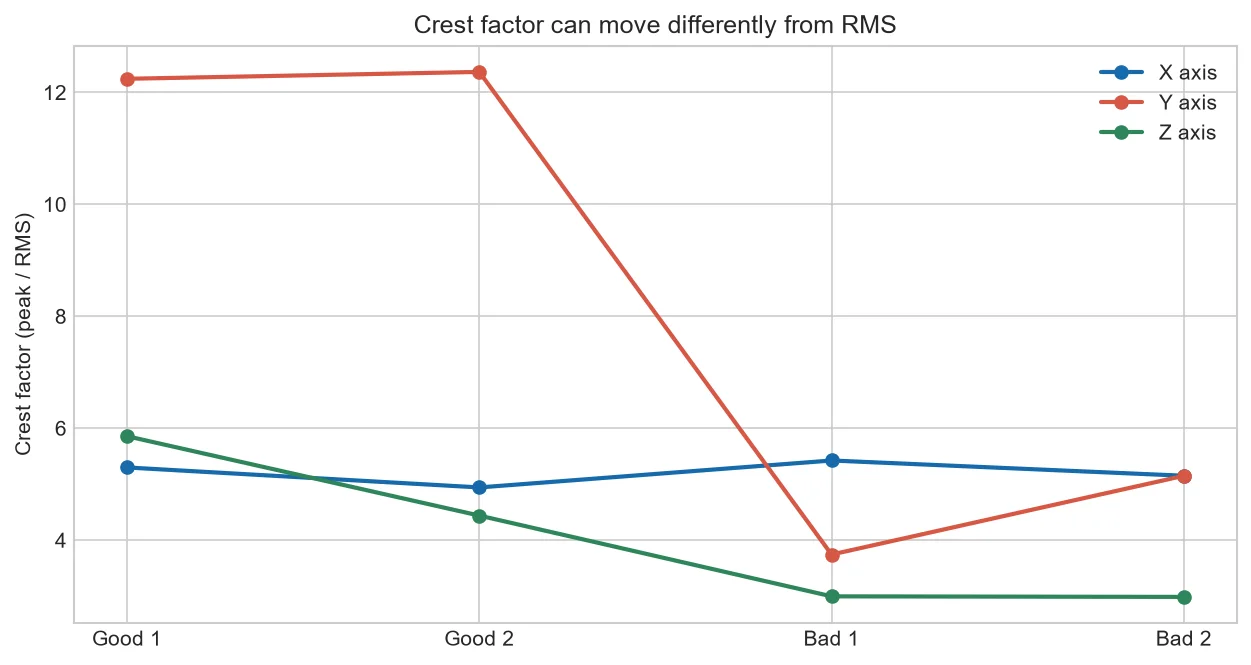
The selected good OP01 files have a high Y-axis crest factor, while sampled bad files show a lower value. At the same time, bad-file Y RMS is higher on average. This is exactly why a ratio cannot be read in isolation.
Where it helps
Crest factor can highlight sparse impacts before they dominate RMS. It may be useful alongside envelope methods or band-specific features when the measurement bandwidth and sensor mounting support the intended analysis.
Build a multi-feature alert
Trend RMS, peak, crest factor, and selected frequency-band energy. Require persistence across more than one cycle where safety allows. Then attach the trace and operating context to the maintenance review.
Reading a ratio without being fooled
One selected good file has Y-axis RMS near 170 and an absolute peak near 2,076, producing a crest factor around 12.2. One selected bad file has Y RMS near 228 and peak near 853, giving a crest factor around 3.7. The bad example has more RMS energy but a less exceptional maximum.
If we looked only for a rising crest factor, this change could be missed. The correct reading is that the waveform shape and energy distribution changed. RMS, peak and the raw trace explain the ratio together.
| Situation | RMS | Peak | Crest factor tendency |
| Sparse tall impacts | Low to moderate | High | Often high |
| Sustained broad vibration | High | Moderate to high | May fall |
| Both rise proportionally | Higher | Higher | May remain similar |
Common mistakes to avoid
- Assuming lower crest factor always means improvement.
- Dividing by a near-zero RMS value without a quality rule.
- Comparing crest factor from different window lengths and process states.
- Using the ratio without showing its peak and RMS components.
Frequently asked questions
What is a good crest factor?
There is no universal healthy value for CNC processes. Establish a matched baseline and interpret the trend with other features.
Can crest factor detect bearing damage?
It can respond to impulsive behavior, but it cannot identify a bearing fault without supporting frequency and inspection evidence.
Why does crest factor change with window length?
A longer window may increase or dilute RMS while the largest peak stays the same, changing the ratio.
About the data used in this guide
The charts use selected files from machine M01, operation OP01. The source records tri-axial acceleration at 2 kHz and labels process examples as good or bad. Our initial charts use two files from each label. They are teaching examples, not universal fault thresholds.
Dataset: CNC Machining Data, CC BY 4.0. Recommended citation: Tnani, Mohamed-Ali; Feil, Michael; Diepold, Klaus. Smart Data Collection System for Brownfield CNC Milling Machines: A New Benchmark Dataset for Data-Driven Machine Monitoring. Procedia CIRP 107 (2022), 131–136. Research paper.
We explain what the selected data supports and avoid naming a mechanical fault when the dataset only provides a good/bad process label. A machine should be inspected by a qualified person before maintenance or safety decisions are made.