CNC Condition Monitoring
OP01 vs OP02: Process-Specific CNC Vibration Baselines
See why different machining operations need separate vibration references, even on the same CNC machine.
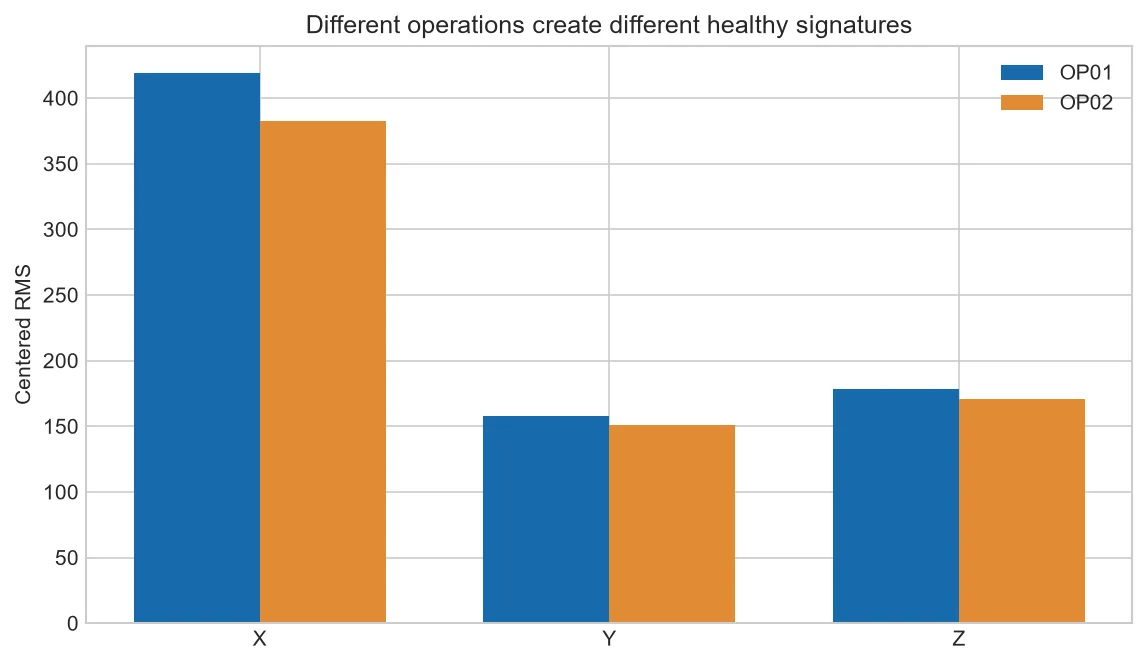
Changing the operation changes the forces. Tool engagement, feed, spindle speed and path all shape vibration, so mixing OP01 and OP02 can make a healthy process look abnormal.
What changes between operations
The cutter, engagement and motion profile can change together. Even when the machine is healthy, RMS and spectrum shape may shift substantially.
The danger of one cycle-wide feature
A full part cycle may include idle, rapid moves and several cuts. One average can dilute a short abnormal operation or be driven by the longest step.
A better data unit
Create a record for a named operation with consistent start and stop rules. Store program and tool identifiers beside it.
How to handle revisions
When feeds, speeds or toolpaths change, compare old and new distributions. If the change is permanent, create a new baseline version rather than stretching the old limits.
Segment before calculating
Suppose OP01 lasts 15 seconds and OP02 lasts 25 seconds. A whole-cycle RMS gives OP02 more influence simply because it is longer.
Calculate features inside each operation boundary. The resulting values answer a clearer question and can be tied to the responsible tool and process step.
| Data unit | Risk |
| Whole part cycle | Short events can be diluted |
| Fixed clock window | May capture different process states |
| Operation window | Needs reliable state alignment |
Common mistakes to avoid
- Mixing roughing and finishing.
- Using file name alone as process truth.
- Changing program timing without updating segmentation.
Frequently asked questions
Can one operation have multiple baselines?
Yes, for different tools, materials or approved recipes.
What if controller events are unavailable?
Use repeatable signal events and verify alignment manually.
Should idle be monitored separately?
It can reveal different machine behavior and should not be mixed blindly with cutting.
Practical workflow for this method
Create a process map before calculating features. Mark when OP01 begins and ends, which tool is active, and whether the record includes approach or retract motion. Apply the same map to healthy and anomalous files. If boundaries drift, align them with controller events or a repeatable signal landmark.
A useful hierarchy is machine → program → operation → approved recipe. The recipe can include tool family, material and feed/speed range. Start with narrow groups; merge them only after data shows their healthy distributions are similar. Merging first may create wide limits that never detect a useful change.
When one operation changes while the rest of the cycle remains stable, report the alert at operation level. The operator then knows which tool and part feature to inspect instead of receiving a vague whole-machine warning.
About the data used in this guide
The charts use a small teaching sample selected from machines M01, M02 and M03, primarily operations OP01 and OP02. The source records tri-axial acceleration at 2 kHz and labels available examples as good or bad. Label coverage is uneven across machine-operation groups, so missing groups are not treated as healthy evidence. These figures are transparent worked examples, not population estimates or universal fault thresholds.
Dataset: CNC Machining Data, CC BY 4.0. Recommended citation: Tnani, Mohamed-Ali; Feil, Michael; Diepold, Klaus. Smart Data Collection System for Brownfield CNC Milling Machines: A New Benchmark Dataset for Data-Driven Machine Monitoring. Procedia CIRP 107 (2022), 131–136. Research paper.
We explain what the selected data supports and avoid naming a mechanical fault when the dataset only provides a good/bad process label. A machine should be inspected by a qualified person before maintenance or safety decisions are made.