CNC Condition Monitoring
Precision and Recall for Rare CNC Vibration Events
Understand why precision-recall analysis is useful when abnormal CNC events are uncommon and thresholds must be selected carefully.
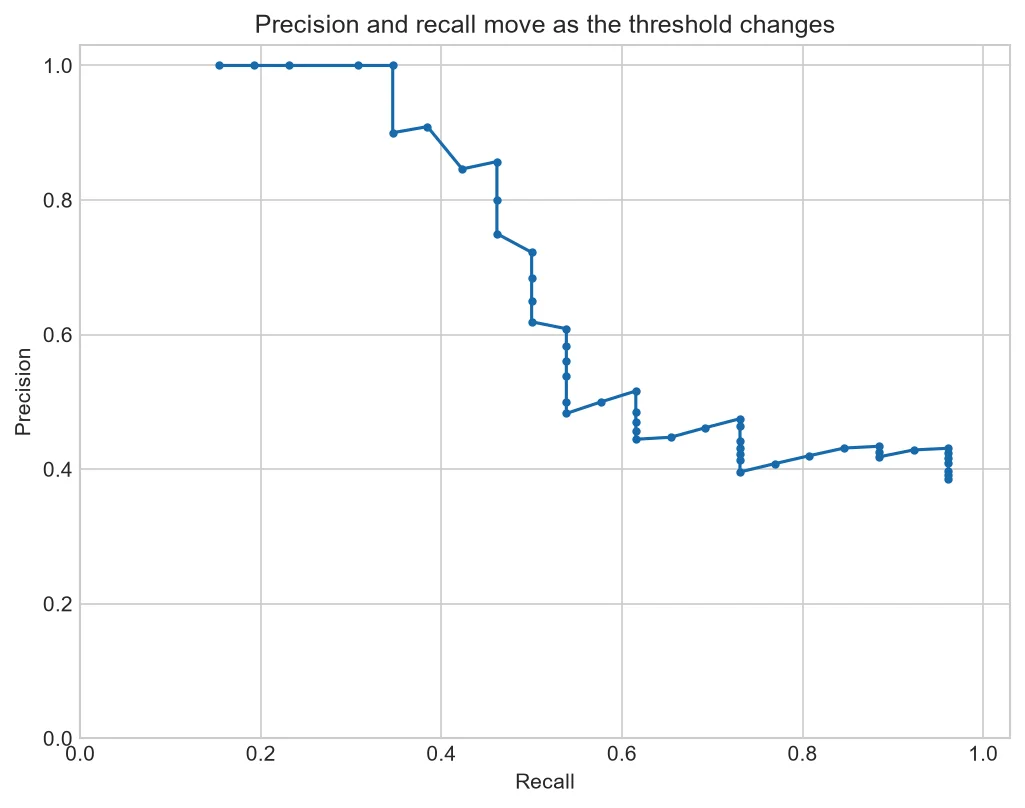
In condition monitoring, the events people care about are often uncommon. Precision asks how many alerts were relevant, while recall asks how many labeled events the rule found.
Precision controls trust and workload
Low precision means most alerts are false positives. Even a sensitive system will be ignored if operators repeatedly find nothing useful.
Recall controls missed evidence
High recall means fewer labeled events were missed, but it can be purchased by lowering the threshold until alerts become impractical.
Why the curve changes
Each point represents a threshold. Moving along the curve exchanges review burden for sensitivity; there is no universally best point.
Window metrics can inflate confidence
Hundreds of overlapping windows from one event are not hundreds of independent detections. Aggregate them into events or cycles before reporting operational performance.
Select a reviewable operating point
Estimate how many cycles run per day and the maximum alerts a team can inspect. Filter thresholds by that workload, then compare recall among feasible choices.
Validate the chosen point on a later or grouped test set. Do not reselect it after viewing final outcomes.
| Metric | Question |
| Precision | When we alert, how often is the label positive? |
| Recall | Of positive labels, how many did we alert? |
| Alerts/day | Can the workflow absorb the result? |
Common mistakes to avoid
- Ignoring prevalence.
- Picking the prettiest point on test data.
- Counting overlapping windows independently.
Frequently asked questions
Is high recall enough?
No, not if alert volume destroys usability.
Why not use ROC alone?
Precision-recall often exposes rare-event workload more directly.
Does the curve select a threshold?
No; operational requirements must select it.
Practical workflow for this method
Report precision and recall by machine, operation and time period to expose concentrated failures.
For early warning, add detection delay and event coverage because point metrics omit when the first useful alert occurred.
About the data used in this guide
The charts use a small teaching sample selected from machines M01, M02 and M03, across the available OP01–OP06 files. The source records tri-axial acceleration at 2 kHz and labels available examples as good or bad. Label coverage is uneven across machine-operation groups, so missing groups are not treated as healthy evidence. These figures are transparent worked examples, not population estimates or universal fault thresholds.
Dataset: CNC Machining Data, CC BY 4.0. Recommended citation: Tnani, Mohamed-Ali; Feil, Michael; Diepold, Klaus. Smart Data Collection System for Brownfield CNC Milling Machines: A New Benchmark Dataset for Data-Driven Machine Monitoring. Procedia CIRP 107 (2022), 131–136. Research paper.
We explain what the selected data supports and avoid naming a mechanical fault when the dataset only provides a good/bad process label. A machine should be inspected by a qualified person before maintenance or safety decisions are made.