CNC Condition Monitoring
CNC Vibration Drift Over Time: How to Separate Change from Noise
Compare healthy files from different dates and design time-based monitoring that does not learn slow faults as normal.
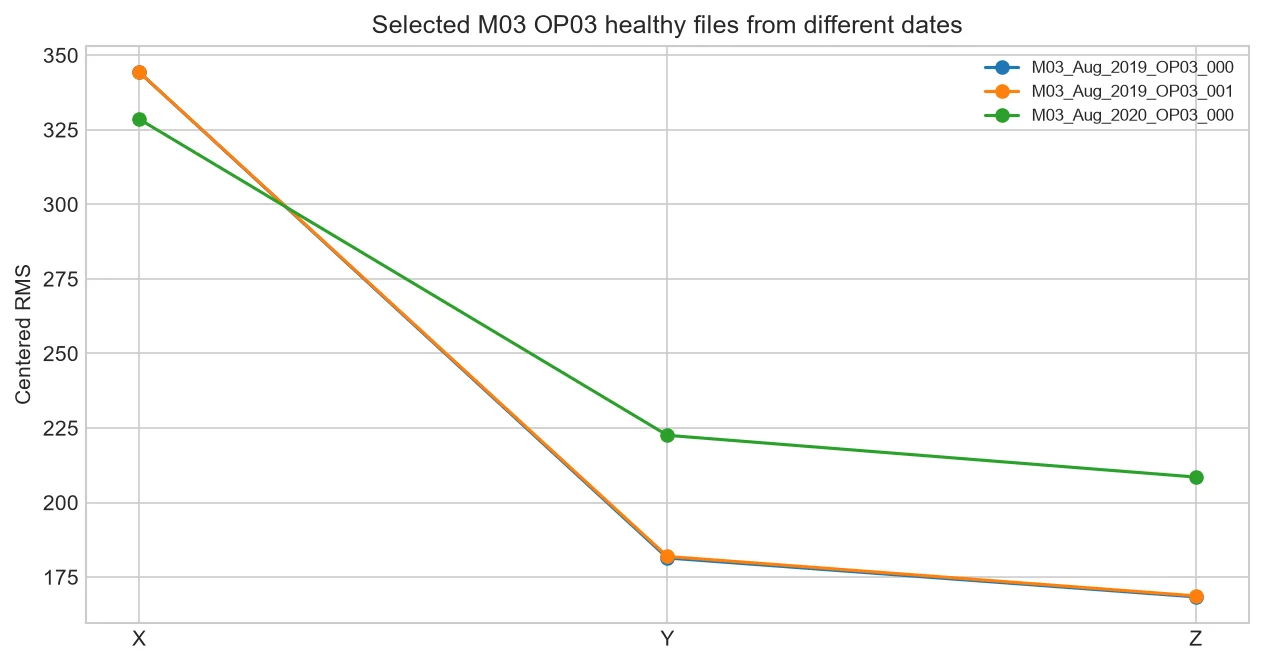
Healthy does not mean identical. Machines warm, tools change and maintenance occurs. Time-based analysis asks whether the reference remains stable enough for an old threshold to stay useful.
Read the dated lines
Each line is one selected healthy file. Differences may be normal variation, setup changes or drift; filenames alone cannot identify the cause.
Separate step change from drift
A sudden permanent shift after maintenance differs from a gradual trend. Both need change records.
Test on future periods
Train or set limits on earlier data and evaluate later records without using future statistics.
Control adaptation
Require verified healthy status before new data can update a baseline.
A safe baseline update rule
Keep a fixed reference and a shadow rolling reference. Compare them weekly. If the rolling center shifts, investigate before replacing the fixed baseline.
Approve an update only after confirming sensor setup, part quality and maintenance state. Store the effective date and previous parameters.
| Pattern | Next action |
| Random spread | Estimate normal variability |
| Sudden step | Check maintenance or setup change |
| Slow movement | Inspect wear, environment and process drift |
Common mistakes to avoid
- Shuffling dates before evaluation.
- Letting alerts update the baseline.
- Ignoring machine warm-up.
Frequently asked questions
Is drift always a fault?
No. It can reflect legitimate process or setup change.
How often should trends be reviewed?
According to cycle volume and process risk.
Can a rolling baseline hide damage?
Yes, if it adapts to an emerging problem.
Practical workflow for this method
Plot raw features, normalized distance and event annotations on one timeline. This makes explanations testable.
Use change-point detection as an aid, not a diagnosis; confirm every important change with process evidence.
Use a timeline split that leaves a meaningful future block untouched until the method is finalized. Repeated tuning on the latest block turns it into training data.
Annotate tool replacements, spindle service, sensor work and program revisions on the trend so signal changes can be checked against recorded events.
Measure drift over fixed review periods. Compare the recent healthy median with a frozen reference, then calculate the change relative to normal spread. A small numerical shift may be important for a stable process, while a larger shift may be ordinary for a variable one.
Create rules for known interventions. After spindle service, collect verification parts and compare pre- and post-service features. If the new state is accepted, establish a dated baseline version instead of blending both states into one wide reference.
About the data used in this guide
The charts use a small teaching sample selected from machines M01, M02 and M03, primarily operations OP03 and OP04. The source records tri-axial acceleration at 2 kHz and labels available examples as good or bad. Label coverage is uneven across machine-operation groups, so missing groups are not treated as healthy evidence. These figures are transparent worked examples, not population estimates or universal fault thresholds.
Dataset: CNC Machining Data, CC BY 4.0. Recommended citation: Tnani, Mohamed-Ali; Feil, Michael; Diepold, Klaus. Smart Data Collection System for Brownfield CNC Milling Machines: A New Benchmark Dataset for Data-Driven Machine Monitoring. Procedia CIRP 107 (2022), 131–136. Research paper.
We explain what the selected data supports and avoid naming a mechanical fault when the dataset only provides a good/bad process label. A machine should be inspected by a qualified person before maintenance or safety decisions are made.