CNC Condition Monitoring
Rolling RMS for CNC Vibration: Choosing a Useful Window
Learn how rolling RMS exposes changing vibration inside a CNC cycle and how to select a window without hiding short events.
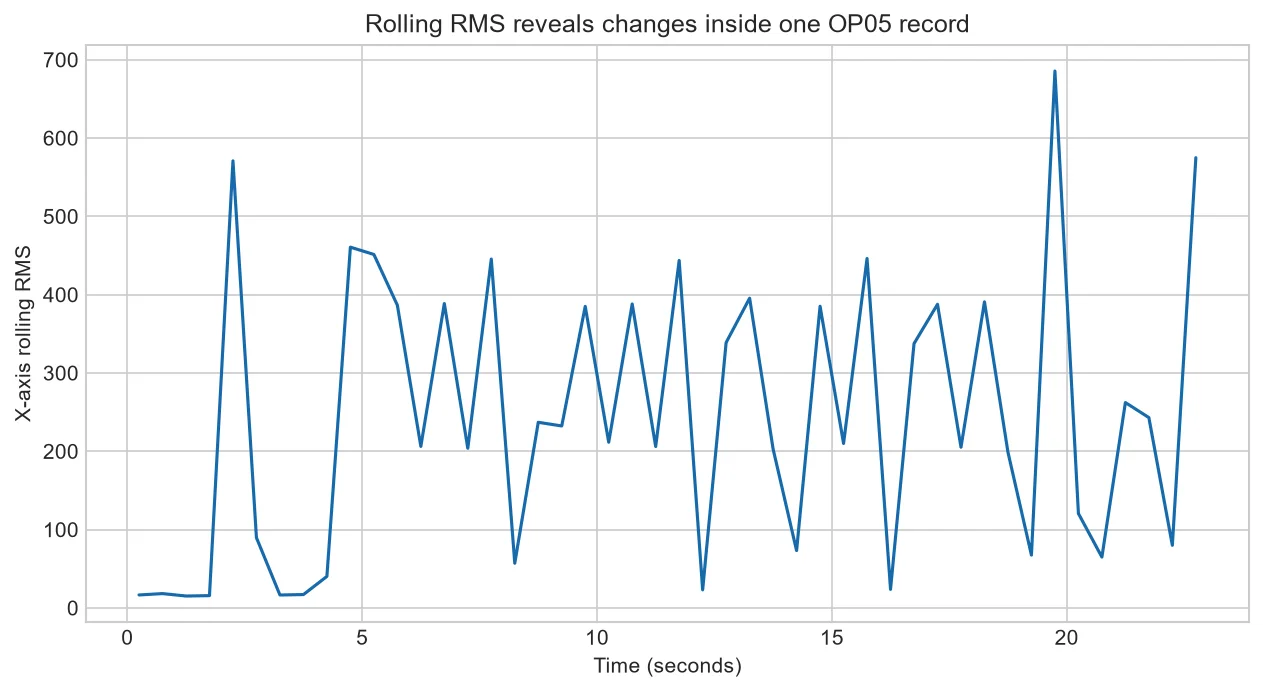
One RMS value compresses an entire recording into a single number. Rolling RMS keeps the calculation local, making it easier to see where vibration builds, settles or spikes during a machining cycle.
What rolling RMS measures
A window moves sample by sample through the signal. At each position, it squares the values, averages them and takes the square root. The result follows changing vibration energy while remaining easier to read than the raw waveform.
What the chart can and cannot say
The plotted OP05 examples show how local energy changes over time. A higher section is not automatically a fault: tool engagement, acceleration and cutting load can all raise RMS during a healthy cycle.
Choose a defensible window
A short window reacts quickly but looks noisy. A long window is stable but can smear impacts and phase boundaries. Start with the shortest process event that matters, then test whether nearby window lengths preserve the same conclusion.
Make cycles comparable
Align records to a repeatable event such as spindle start, first contact or a controller marker. Without alignment, the same healthy phase may appear at different positions and create false differences.
A practical setup
At 2 kHz, a 200-sample window represents 0.1 seconds. Calculate several candidates around that duration and plot them together before choosing one.
Store sampling rate, window length, overlap, axis and operation with the feature. A rolling statistic without these settings cannot be reproduced.
| Window | Likely behavior |
| Short | Fast response, more variation |
| Medium | Balanced trend view |
| Long | Smooth result, delayed events |
Common mistakes to avoid
- Comparing unaligned cycles.
- Changing the window after seeing test labels.
- Treating every RMS rise as damage.
Frequently asked questions
Is rolling RMS better than full-cycle RMS?
It answers a different question: where energy changes rather than only how much the whole cycle contains.
Can one window serve every operation?
Only after validation; operation timing often differs.
Should windows overlap?
They may, but document overlap because it affects the number and dependence of observations.
Practical workflow for this method
Segment the operation into engineering phases and summarize rolling RMS within each phase. This produces interpretable features tied to process events.
Estimate healthy variation across dates and tools before setting limits. One visually smooth trace is not enough evidence for an alarm.
About the data used in this guide
The charts use a small teaching sample selected from machines M01, M02 and M03, primarily operations OP05 and OP06. The source records tri-axial acceleration at 2 kHz and labels available examples as good or bad. Label coverage is uneven across machine-operation groups, so missing groups are not treated as healthy evidence. These figures are transparent worked examples, not population estimates or universal fault thresholds.
Dataset: CNC Machining Data, CC BY 4.0. Recommended citation: Tnani, Mohamed-Ali; Feil, Michael; Diepold, Klaus. Smart Data Collection System for Brownfield CNC Milling Machines: A New Benchmark Dataset for Data-Driven Machine Monitoring. Procedia CIRP 107 (2022), 131–136. Research paper.
We explain what the selected data supports and avoid naming a mechanical fault when the dataset only provides a good/bad process label. A machine should be inspected by a qualified person before maintenance or safety decisions are made.