CNC Condition Monitoring
Why Every CNC Machine Needs Its Own Vibration Baseline
Learn how machine identity changes healthy vibration and how to build local baselines without losing fleet-wide visibility.
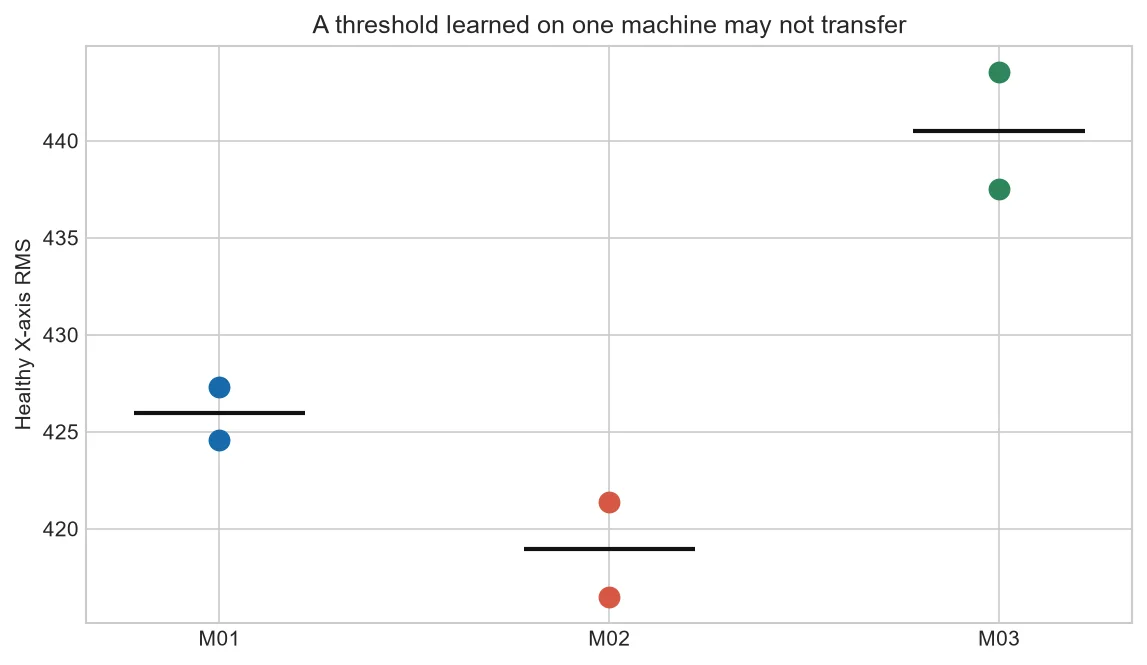
A threshold becomes trustworthy only when we know what population it represents. A limit learned on M01 may create nuisance alarms on M02 or miss a meaningful change on M03.
A baseline is conditional
State the machine, operation, sensor setup, tool family and process window. Without these conditions, the number has no stable meaning.
Local does not mean isolated
Store common features across the fleet, but express condition as distance from each machine’s healthy range. This lets a dashboard compare relative behavior without pretending raw amplitudes are identical.
When to rebuild
Review the reference after sensor remounting, spindle work, major alignment, foundation changes or a permanent process revision. Do not erase the old version; keep it for traceability.
How to approve a new baseline
Collect verified healthy cycles, review their spread, test historical events and ask operators whether alerts correspond with physical findings. A statistical line alone is not acceptance.
From fleet rule to local limit
A fleet rule might flag a persistent rise of 30 percent above a rolling healthy reference. The underlying raw RMS values can still differ between M01 and M03.
Before use, check the rule against each machine’s healthy variation. A 30 percent rise may be meaningful on a stable process and ordinary on a highly variable one.
| Layer | Purpose |
| Raw feature | Engineering traceability |
| Local baseline distance | Machine condition trend |
| Fleet rule | Consistent workflow and escalation |
Common mistakes to avoid
- Overwriting the old baseline.
- Updating a baseline during an unexplained fault.
- Using too few operating conditions.
Frequently asked questions
Can a baseline adapt automatically?
It can, but adaptation must not learn an emerging fault as normal.
How often should it be reviewed?
After defined changes and on a scheduled quality review.
Who should approve it?
Someone who understands both the process and measurement method.
Practical workflow for this method
A practical baseline record should identify the machine, sensor, mounting point, orientation, program, operation, tool, material and acquisition settings. Save the healthy feature distribution rather than only its average. The spread tells you how much movement is ordinary before an alert becomes useful.
Use warning and action logic carefully. A warning might require several consecutive cycles outside the reference band. An action level may require a larger deviation or confirmation from another signal such as spindle load or part quality. The exact rules should reflect process risk and the time available for inspection.
When maintenance changes the machine, keep the old and new baselines side by side during a transition period. This shows whether the expected change occurred and prevents history from being silently rewritten.
About the data used in this guide
The charts use a small teaching sample selected from machines M01, M02 and M03, primarily operations OP01 and OP02. The source records tri-axial acceleration at 2 kHz and labels available examples as good or bad. Label coverage is uneven across machine-operation groups, so missing groups are not treated as healthy evidence. These figures are transparent worked examples, not population estimates or universal fault thresholds.
Dataset: CNC Machining Data, CC BY 4.0. Recommended citation: Tnani, Mohamed-Ali; Feil, Michael; Diepold, Klaus. Smart Data Collection System for Brownfield CNC Milling Machines: A New Benchmark Dataset for Data-Driven Machine Monitoring. Procedia CIRP 107 (2022), 131–136. Research paper.
We explain what the selected data supports and avoid naming a mechanical fault when the dataset only provides a good/bad process label. A machine should be inspected by a qualified person before maintenance or safety decisions are made.