CNC Condition Monitoring
Can a CNC Anomaly Model Transfer to a New Machine?
A practical guide to testing model transfer, calibrating local baselines and deciding when retraining is necessary.
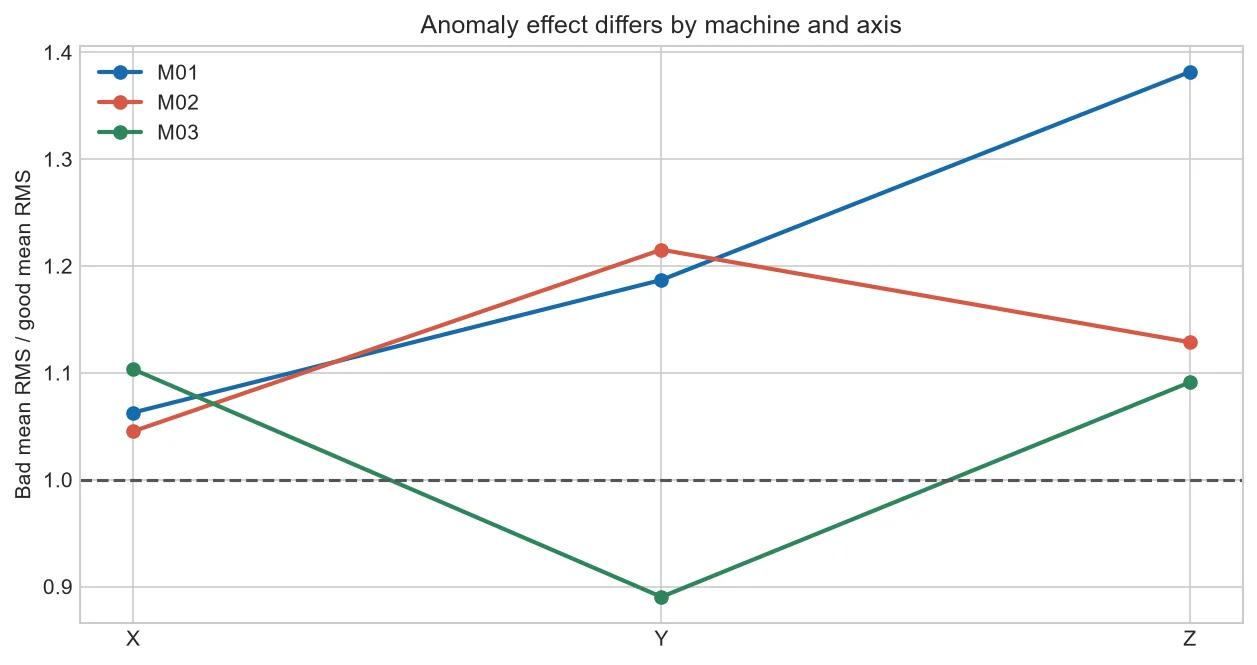
A model that works on M01 may fail on M02 even when both run OP01. Machine identity can be stronger than the condition pattern the model is supposed to learn.
Three transfer levels
Direct transfer uses the old model unchanged. Calibration adjusts the new machine’s reference. Fine-tuning or retraining changes model parameters.
Start with healthy calibration
Healthy data is easier and safer to collect than faults. Use it to examine scale, axis balance and feature distribution before enabling alerts.
Test the real claim
If the model promises cross-machine use, hold out a whole machine during development. Random file splits cannot support that claim.
Deploy gradually
Run alerts in shadow mode, review them with operators, document false alarms and only then connect the output to maintenance workflow.
A cautious transfer workflow
Install the sensor in a documented location and collect healthy data before enabling decisions. Compare raw feature ranges with the source machine and apply local normalization if justified.
Run the transferred model in shadow mode. Review alerts without triggering automatic maintenance. If false alarms concentrate in one operation, update segmentation or build an operation-specific model.
| Stage | Action |
| Direct test | Evaluate unchanged model |
| Calibration | Fit local healthy reference |
| Retraining | Use new labeled evidence |
Common mistakes to avoid
- Calling calibration successful without anomaly tests.
- Using the new machine’s test data for tuning.
- Automating maintenance immediately.
Frequently asked questions
How much local data is needed?
Enough to cover expected healthy operating variation; the exact count depends on stability.
When is retraining necessary?
When feature relationships or process behavior differ beyond a scale shift.
Can transfer reduce data collection?
Yes, but it does not eliminate local validation.
Practical workflow for this method
Begin transfer with a compatibility audit. Confirm sample rate, sensor orientation, feature formulas, operation mapping and units. Then compare healthy raw distributions. If differences are mainly scale and offset, local calibration may be enough. If relationships between features change, retraining is more likely to be necessary.
Use staged deployment. In shadow mode, the model scores cycles but does not create work orders. Engineers review alerts and tag their causes. Next, enable advisory alerts with a manual confirmation step. Automatic actions should be considered only after stable performance and an appropriate safety review.
Keep the source model, calibration parameters and local model versions separate. When performance changes, this record shows whether the cause was new data, a new threshold or changed model logic.
About the data used in this guide
The charts use a small teaching sample selected from machines M01, M02 and M03, primarily operations OP01 and OP02. The source records tri-axial acceleration at 2 kHz and labels available examples as good or bad. Label coverage is uneven across machine-operation groups, so missing groups are not treated as healthy evidence. These figures are transparent worked examples, not population estimates or universal fault thresholds.
Dataset: CNC Machining Data, CC BY 4.0. Recommended citation: Tnani, Mohamed-Ali; Feil, Michael; Diepold, Klaus. Smart Data Collection System for Brownfield CNC Milling Machines: A New Benchmark Dataset for Data-Driven Machine Monitoring. Procedia CIRP 107 (2022), 131–136. Research paper.
We explain what the selected data supports and avoid naming a mechanical fault when the dataset only provides a good/bad process label. A machine should be inspected by a qualified person before maintenance or safety decisions are made.