CNC Condition Monitoring
Detecting CNC Vibration Data Drift Before Alerts Degrade
Distinguish operation changes, sensor changes and gradual feature drift before they silently damage CNC monitoring performance.
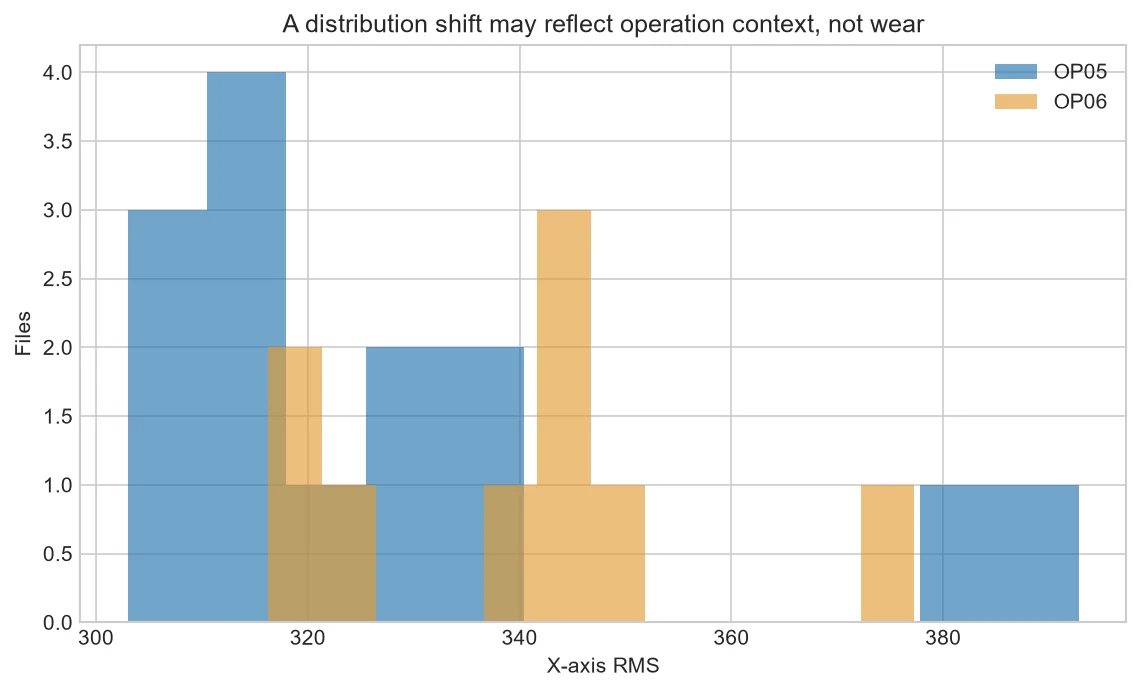
Data drift means the incoming feature distribution has changed. It is an early warning about the monitoring system, not proof that the machine is failing.
Expected drift versus unwanted drift
A new program or load may legitimately move features. Sensor loosening, unit changes and preprocessing revisions can create unwanted measurement drift.
Choose reference windows
Compare recent stable-duration windows with a versioned baseline from the same operation. Very short windows create noisy drift metrics; very long windows respond slowly.
Use several views
Track medians, spread, missingness and context mix. A single population-stability number can hide the reason for movement.
Do not automate the wrong response
Retraining immediately can absorb a developing problem into normal behavior. Require review, inspection or verified process explanation first.
Create a drift triage panel
Show feature change, operation mix, sensor quality and recent maintenance annotations together. Route measurement drift to instrumentation and process drift to production review.
Freeze the old baseline until the change is explained. If a new normal is approved, create a new version rather than overwriting history.
| Observed change | First question |
| All axes scale together | Units, gain or mount? |
| One operation shifts | Program, tool or load? |
| Missingness rises | Acquisition reliability? |
| Gradual feature movement | Wear, environment or reference aging? |
Common mistakes to avoid
- Equating every drift alarm with failure.
- Comparing mixed operation proportions.
- Automatically retraining on unexplained data.
Frequently asked questions
Is drift always bad?
No; it can document a legitimate process change.
Can labels detect drift?
Feature drift can be monitored before labels arrive, while performance drift needs outcomes.
Should thresholds move with drift?
Not until the cause and new reference are validated.
Practical workflow for this method
Backtest drift rules across known context transitions to estimate nuisance alarms.
Record the investigation outcome so future changes can be matched with prior sensor, process or maintenance patterns.
About the data used in this guide
The charts use a small teaching sample selected from machines M01, M02 and M03, across the available OP01–OP06 files. The source records tri-axial acceleration at 2 kHz and labels available examples as good or bad. Label coverage is uneven across machine-operation groups, so missing groups are not treated as healthy evidence. These figures are transparent worked examples, not population estimates or universal fault thresholds.
Dataset: CNC Machining Data, CC BY 4.0. Recommended citation: Tnani, Mohamed-Ali; Feil, Michael; Diepold, Klaus. Smart Data Collection System for Brownfield CNC Milling Machines: A New Benchmark Dataset for Data-Driven Machine Monitoring. Procedia CIRP 107 (2022), 131–136. Research paper.
We explain what the selected data supports and avoid naming a mechanical fault when the dataset only provides a good/bad process label. A machine should be inspected by a qualified person before maintenance or safety decisions are made.