CNC Condition Monitoring
Closing the Loop Between CNC Alerts and Maintenance Findings
Design a feedback workflow that connects vibration alerts, operator review and inspection outcomes without silently rewriting history.
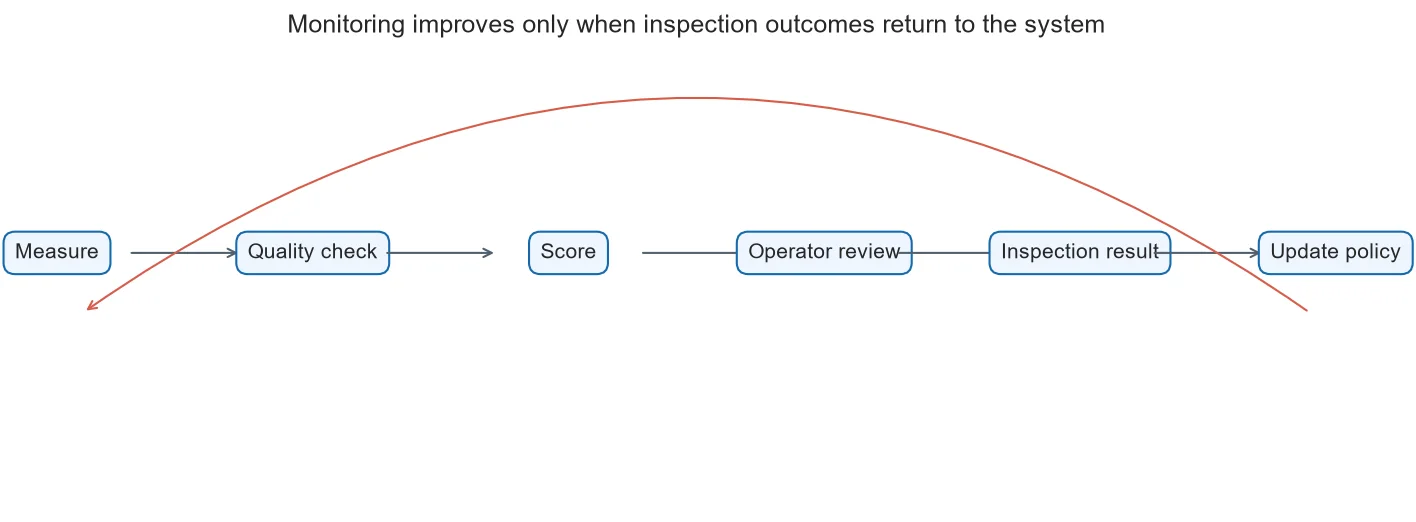
A model that only produces alerts cannot learn whether those alerts helped. A useful program records what people inspected, what they found and what action changed the machine or measurement system.
Begin with traceable evidence
An alert record should contain source files, feature values, limits, context, software version and timestamps. Screenshots alone are difficult to reproduce.
Capture the human result
Operators and technicians need simple structured outcomes such as no issue found, process change, sensor issue, tool issue or confirmed mechanical finding, plus free-text notes.
Separate feedback from automatic learning
A closed ticket is not necessarily a negative label. Review label quality and keep model updates in a versioned approval process.
Measure program value
Track confirmed findings, avoided downtime where defensible, review time, nuisance alerts, detection delay and unresolved cases. Model accuracy is only part of operational success.
Define an alert lifecycle
Create states for new, acknowledged, inspected, action taken, monitoring and closed. Require a reason and evidence for each transition.
Review outcomes monthly by machine and operation. Change thresholds only through a documented proposal, validation result and effective date.
| Lifecycle step | Record |
| Detection | Data and rule version |
| Review | Context and owner |
| Inspection | Observed finding |
| Action | Maintenance or process change |
| Closure | Outcome and follow-up |
Common mistakes to avoid
- Treating every closed alert as false.
- Overwriting old thresholds.
- Collecting free text with no consistent categories.
Frequently asked questions
Who should own feedback?
Responsibilities should be shared but explicit across operations, maintenance and monitoring engineering.
Can operator notes train a model?
Only after label definitions and quality review.
How long should evidence be retained?
Follow operational, contractual and regulatory needs while preserving enough history to audit performance.
Practical workflow for this method
Build dashboards from immutable alert events and separate correction records rather than editing past events in place.
Schedule periodic no-alert reviews too; silent periods can mean stable production, broken acquisition or thresholds that are too high.
About the data used in this guide
The charts use a small teaching sample selected from machines M01, M02 and M03, across the available OP01–OP06 files. The source records tri-axial acceleration at 2 kHz and labels available examples as good or bad. Label coverage is uneven across machine-operation groups, so missing groups are not treated as healthy evidence. These figures are transparent worked examples, not population estimates or universal fault thresholds.
Dataset: CNC Machining Data, CC BY 4.0. Recommended citation: Tnani, Mohamed-Ali; Feil, Michael; Diepold, Klaus. Smart Data Collection System for Brownfield CNC Milling Machines: A New Benchmark Dataset for Data-Driven Machine Monitoring. Procedia CIRP 107 (2022), 131–136. Research paper.
We explain what the selected data supports and avoid naming a mechanical fault when the dataset only provides a good/bad process label. A machine should be inspected by a qualified person before maintenance or safety decisions are made.