
In the world of precision engineering and high-volume production, Computer Numerical Control (CNC) machines stand as the backbone of modern manufacturing. These automated powerhouses transform raw materials like metal, wood, plastic, and composites into intricate components with unparalleled accuracy, speed, and repeatability. But what exactly are CNC machines, and why do they dominate industries from aerospace to automotive?
At their core, CNC machines are computer-controlled tools that execute pre-programmed sequences of commands—often in G-code—to dictate the movement of cutting tools, spindles, or torches across multiple axes (X, Y, Z, and rotational A, B, C). This subtractive manufacturing process removes material from a workpiece until the desired shape emerges, eliminating human error and enabling 24/7 operation. The global CNC market is projected to exceed $100 billion by 2025, driven by demands for customization, efficiency, and miniaturization.
While there are over a dozen CNC variants, five types reign supreme due to their versatility, cost-effectiveness, and widespread adoption: CNC Milling Machines, CNC Lathes (Turning Centers), CNC Routers, CNC Plasma Cutters, and CNC Laser Cutters. Each excels in specific applications, materials, and tolerances, making the right choice pivotal for manufacturers. This comprehensive guide dives deep into each, exploring their mechanics, advantages, limitations, real-world uses, and comparisons—equipping you with the knowledge to revolutionize your production line.
1. CNC Milling Machines: The Versatile Workhorses of Precision Machining

CNC milling machines are arguably the most ubiquitous and flexible CNC type, capable of producing everything from simple slots to complex 3D geometries. They operate by rotating a multi-point cutting tool (end mill, face mill, etc.) mounted on a spindle, while the workpiece is secured on a movable table. The spindle moves along linear axes (typically 3-5) to carve away material.
How They Work
A typical 3-axis mill moves in X (left-right), Y (front-back), and Z (up-down). Advanced 5-axis models add rotational A and B axes for undercuts and contoured surfaces without repositioning. G-code dictates feed rates (e.g., 100 IPM), spindle speeds (up to 20,000 RPM), and tool changes via automatic tool changers (ATC) with 20-100 tools. Coolant floods the cut to manage heat and chips.
Mills come in vertical (spindle above table, ideal for flat parts) and horizontal (spindle sideways, better for heavy stock removal) configurations. Subtypes include knee mills (manual adjustment) and bed mills (fixed bed for rigidity).
Applications and Materials
Milling shines in aerospace (turbine blades), automotive (engine blocks), and medical (implants). It handles metals (aluminum, steel, titanium), plastics, and composites. Tolerances reach ±0.0002 inches on high-end machines.
Example: Boeing uses 5-axis mills to fabricate wing spars from titanium, reducing weight by 20% while maintaining strength.
Pros and Cons
| Aspect | Pros | Cons |
|---|---|---|
| Precision | ±0.001″ standard; sub-micron possible | Tool deflection on deep pockets |
| Versatility | Drilling, boring, threading, contouring | Slower for cylindrical parts (use lathe) |
| Speed | High RPM for fine finishes | Chip evacuation issues in slots |
Costs range from $20,000 (hobbyist 3-axis) to $500,000+ (industrial 5-axis). Maintenance involves spindle rebuilds ($10,000 every 5,000 hours) and calibration.
In summary, milling’s dominance (over 40% market share) stems from its ability to prototype and produce complex parts in one setup.
2. CNC Lathes: Masters of Rotational Symmetry and High-Volume Turning
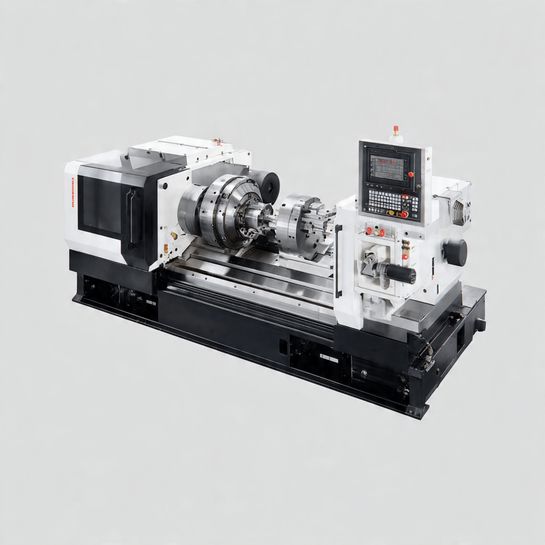
CNC lathes, or turning centers, rotate the workpiece at high speeds (up to 5,000 RPM) while stationary tools remove material radially. Ideal for cylindrical parts, they flip the milling paradigm: the part spins, tools are fixed.
How They Work
The chuck grips bar stock or blanks, spinning it along the Z-axis. Tools on a turret slide in X (radial) and Z (longitudinal). Live tooling adds milling/drilling. Swiss-style lathes slide the bar through a guide bushing for micro-precision (±0.0001″).
2-axis basic; multi-axis (mill-turn) combine turning/milling. Bar feeders enable lights-out operation for 1000s of parts.
Applications and Materials
Perfect for shafts, bushings, fittings in automotive (crankshafts), oil & gas (valves), and electronics (connectors). Excels on metals; handles plastics.
Example: Toyota produces 1 million+ axle shafts yearly on CNC lathes, cutting cycle times by 50%.
Pros and Cons
| Aspect | Pros | Cons |
|---|---|---|
| Efficiency | High-volume; bar-to-part in minutes | Limited to rotationally symmetric parts |
| Surface Finish | Excellent (Ra 0.8-3.2 µm) | Chuck marks require secondary ops |
| Cost | $15,000-$300,000; low per-part cost | Setup time for small batches |
Lathes complement mills: 60% of parts need both (mill-turn hybrids bridge the gap).
3. CNC Routers: Speed Demons for Wood, Plastics, and Prototyping
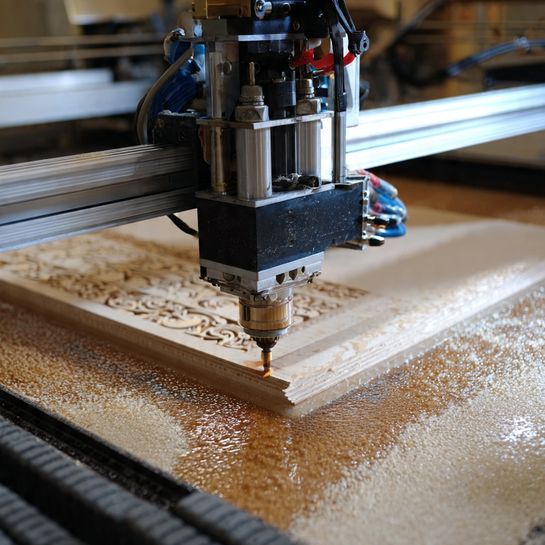
CNC routers resemble mills but prioritize speed over rigidity, using high-velocity spindles (up to 24,000 RPM) for softer materials. Gantry-style frames allow large beds (4×8 ft+).
How They Work
Spindle-mounted bits (straight, ball nose, V-bit) carve 2.5D/3D paths. Vacuum tables secure sheets. Often 3-4 axis; dust collection is key.
Applications and Materials
Signage, furniture, prototypes. Wood, foam, acrylic, aluminum (not hardened steel).
Example: Cabinet makers use routers for custom doors, boosting output 300%.
Pros and Cons
| Aspect | Pros | Cons |
|---|---|---|
| Size/Speed | Large sheets; 1000 IPM feeds | Lower rigidity (±0.005″ tolerance) |
| Affordability | $5,000-$50,000 | Dust/chip management needed |
Routers democratize fabrication for SMEs.
4. CNC Plasma Cutters: Beasts for Thick Metal Fabrication
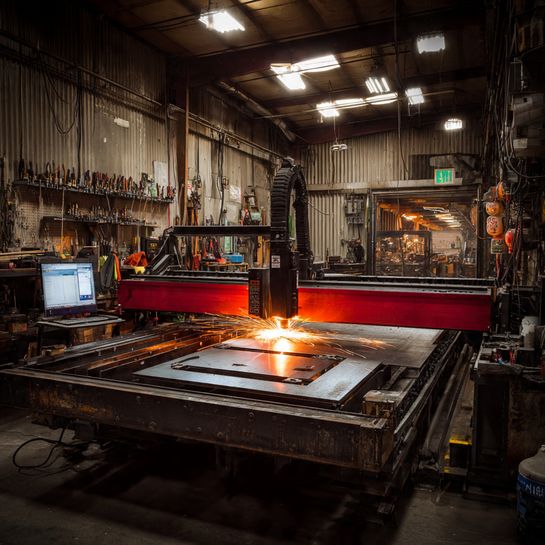
Plasma cutters ionize gas into a 20,000-50,000°F arc to melt conductive metals. Torch height control (THC) maintains kerf (0.1-0.2″).
How They Work
High-velocity gas + electricity = plasma jet. CNC tables (4×8 ft) for sheets up to 2″. Hypertherm torches dominate.
Applications and Materials
HVAC ducts, structural steel. Carbon/mild steel, stainless, aluminum (1-50mm)
Example: Shipyards cut hull plates 10x faster than oxy-fuel.
Pros and Cons
| Aspect | Pros | Cons |
|---|---|---|
| Thickness | Up to 2″ at speed | HAZ (0.03-0.1″); dross (±0.02″) |
| Cost | $10,000-$100,000; cheap consumables | Metals only; noisy |
Ideal for rough cuts needing post-grind.
5. CNC Laser Cutters: Precision Kings for Thin Sheets and Intricacies
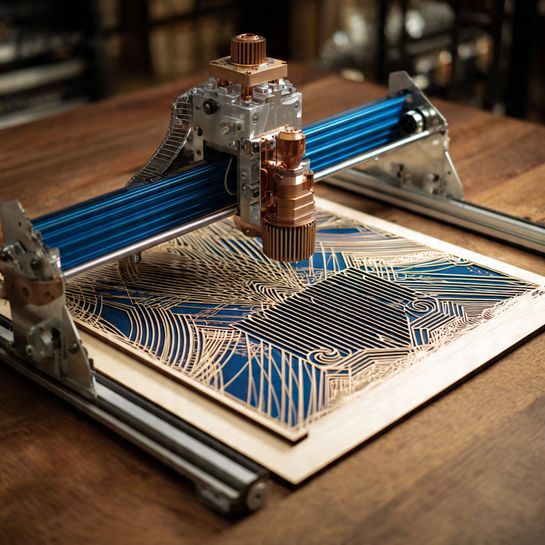
Lasers focus light into a 3000°F beam for vaporization. Fiber (metals) vs. CO2 (non-metals).
How They Work
Mirrors/gallium fibers direct beam; assist gas blows debris. 1000-10,000W power; tolerances ±0.001″.
Applications and Materials
Electronics, jewelry. Metals (<25mm), plastics, wood.
Example: Apple etches iPhone cases with fiber lasers.
Pros and Cons
| Aspect | Pros | Cons |
|---|---|---|
| Accuracy | ±0.0005″; no tool wear | Reflections on copper; thin only |
| Speed | 2000 IPM on sheets | $50,000+; high power costs |
Comparison: Choosing the Right CNC Machine
| Machine Type | Best Materials | Thickness Max | Tolerance | Cost Range | Speed (IPM) |
|---|---|---|---|---|---|
| Milling | Metals/Plastics | Unlimited | ±0.0002″ | $20k-$500k | 100-500 |
| Lathe | Metals | Long bars | ±0.0001″ | $15k-$300k | 500+ RPM |
| Router | Wood/Soft Metals | 6″ | ±0.005″ | $5k-$50k | 1000+ |
| Plasma | Conductive Metals | 2″ | ±0.020″ | $10k-$100k | 500 |
| Laser | Thin Metals/Non-metals | 1″ | ±0.001″ | $30k-$200k | 2000+ |
Future Trends and Conclusion
AI integration, hybrid additive/subtractive, and cobots are evolving CNCs. Invest based on volume, material, and complexity—mills/lathes for precision, plasma/laser for sheets, routers for soft goods.
References:
- https://www.goodwin.edu/enews/five-types-of-cnc-machines-and-how-they-are-used/ goodwin.edu
- https://www.uti.edu/blog/cnc/6-cnc-machines uti.edu
- https://www.findbuytool.com/blogs/university/types-of-cnc-machines findbuytool.com
- https://www.xometry.com/resources/machining/types-of-cnc-machines/ xometry.com
- https://www.bridgewaterstudio.net/blog/the-5-most-common-types-of-cnc-equipment bridgewaterstudio.net
- https://www.cnccookbook.com/understand-cnc-machine-types-a-comprehensive-guide/ cnccookbook.com
- https://3axis-group.com/what-are-the-5-common-types-of-cnc-machines/ 3axis-group.com
- https://avantiengineering.com/5-different-types-of-cnc-machines/ avantiengineering.com
- https://waykenrm.com/blogs/types-of-cnc-machines/ waykenrm.com
- https://www.buildingtalk.com/blog-entry/what-is-cnc-machining-five-most-common-cnc-machines/ buildingtalk.com
- https://www.3erp.com/blog/cnc-machining-types/ 3erp.com
- https://nsflamespray.com/5-basic-types-cnc-machines/ nsflamespray.com
- https://www.rcoeng.com/blog/types-of-cnc-machines rcoeng.com
- https://www.honiron.com/5-types-cnc-machines-commonly-used-metalworking/ honiron.com
- https://cncblogs.com/cnc-industry-blog/what-are-the-5-common-types-of-cnc-machines-2/ cncblogs.com
- https://www.rapiddirect.com/blog/12-types-of-cnc-machines/ rapiddirect.com
- https://www.redline-cnc.co.uk/what-are-the-5-common-types-of-cnc-machines/ redline-cnc.co.uk
- https://damassets.autodesk.net/content/dam/autodesk/www/pdfs/fy17-Types-of-CNC-Machining-ebook-en-FINAL.pdf damassets.autodesk.net
- https://pioneerserviceinc.com/blog/most-common-types-of-precision-cnc-machining/ pioneerserviceinc.com
- https://www.stylecnc.com/industry-news/What-is-the-difference-among-CNC-router-CNC-laser-and-CNC-plasma-cutter.html stylecnc.com
- https://www.adhmt.com/laser-cutting-machine-vs-cnc/ adhmt.com
- https://www.fortunebusinessinsights.com/industry-reports/computer-numerical-controls-cnc-machine-tools-market-101707 fortunebusinessinsights.com
- https://etcnmachining.com/blog/aerospace-cnc-machining/ etcnmachining.com
- https://www.woodweb.com/knowledge_base/CNC_Routers.html lagunatools.com (Note: Adapted from search results on cabinet making)
- https://www.hypertherm.com/solutions/industries/shipbuilding/ hypertherm.com
- https://www.fractory.com/cnc-machining-tolerances/ fractory.com
- https://www.protocase.com/resources/tolerances/profile-cutting.php


